Biblical Mountain
Mount Horeb in the Bible
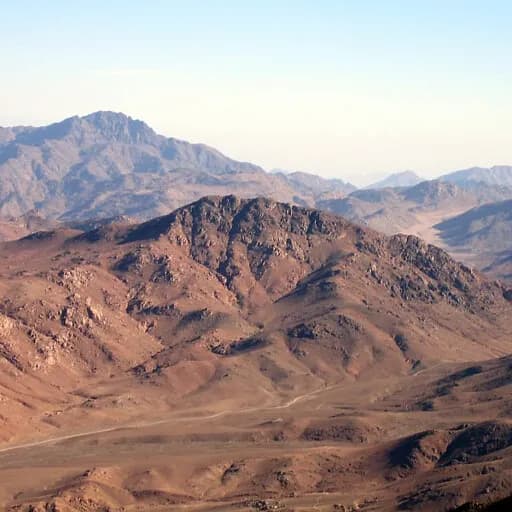
Mount Horeb is a mountain mentioned in 17 verses across 6 books of the Bible. Known today as Jebel Musa.
Verses
17
Books
6
Confidence
Very High
Coordinates
28.5397, 33.9733
Map
Loading map...
Key Verses About Mount Horeb
“his father-in-law”Exodus 3:1 (KJV)
“I will stand before you there on the rock in Horeb. You shall strike the rock”Exodus 17:6 (KJV)
“And the children of Israel stripped themselves of their ornaments by the mount Horeb.”Exodus 33:6 (KJV)
“(There are eleven days' journey from Horeb by the way of mount Seir unto Kadeshbarnea.)”Deuteronomy 1:2 (KJV)
“saying”Deuteronomy 1:6 (KJV)
What the Commentators Say
“Chapter 3 Chapter Outline God appears to Moses in a burning bush.(1-6) God sends Moses to deliver Israel.(7-10) The name Jehovah.(11-15) The deliverance of the Israelites promised.(16-22) **Verses 1-6** The years of the life of Moses are divided into three forties; the first forty he spent as a prince in Pharaoh's court, the second as a shepherd in Midian, the third as a king in Jeshurun. How changeable is the life of man! The first appearance of God to Moses, found him tending sheep. This seems a poor employment for a man of his parts and education, yet he rests satisfied with it; and thus learns meekness and contentment, for which he is more noted in sacred writ, than for all his learning. Satan loves to find us idle; God is pleased when he finds us employed. Being alone, is a good friend to our communion with God. To his great surprise, Moses saw a bush burning without fire to kindle it. The bush burned, and yet did not burn away; an emblem of the church in bondage in Egypt. And it fitly reminds us of the church in every age, under its severest persecutions kept by the presence of God from being destroyed. Fire is an emblem, in Scripture, of the Divine holiness and justice, also of the afflictions and trials with which God proves and purifies his people, and even of that baptism of the Holy Ghost, by which sinful affections are consumed, and the soul changed into the Divine nature and image. God gave Moses a gracious call, to which he returned a ready answer. Those that would have communion with God, must attend upon him in the ordinances wherein he is pleased to manifest himself and his glory, though it be in a bush. Putting off the shoe was a token of respect and submission. We ought to draw nigh to God with a solemn pause and preparation, carefully avoiding every thing that looks light and rude, and unbecoming his service. God does not say, I was the God of Abraham, Isaac, and Jacob, but I am. The patriarchs still live, so many years after their bodies have been in the grave. No length of time can separate the souls of the just from their Maker. By this, God instructed Moses as to another world, and strengthened his belief of a future state. Thus it is interpreted by our Lord Jesus, who, from hence, proves that the dead are raised, Lu 20:37. Moses hid his face, as if both ashamed and afraid to look upon God. The more we see of God, and his grace, and covenant love, the more cause we shall see to worship him with reverence and godly fear.”
Matthew Henry's Concise Commentary on Exodus 3:1
“III. (1) **Moses kept the flock.**—The natural occupation of one who had thrown in his lot with the Midianites. **Jethro, his father-in-law.**—Rather, *his relation by marriage. *The word is one of very wide use, corresponding with the Latin *affinis. *It is even applied to a husband, as in Exodus 4:25. The supposition that it means “father-in-law” has led to the identification of Jethro with Reuel, which is very unlikely. He was more probably Reuel’s son, and Moses’s brother-in-law. His father having died, he had succeeded to his father’s position, and was at once priest and sheikh of the tribe. **To the backside of the desert.**—Heb., *behind the desert*—*i.e., *to the fertile tract which lay behind the sandy plain stretching from the Sinaitic range to the shore of the Elanitic gulf. **The mountain of God**—*i.e., *Sinai. See Exodus 18:5; Exodus 19:2-23, &c. **Even Horeb.**—Rather, *towards Horeb, *or *Horeb way. *Horeb seems to have been the name of the entire mountain region; Sinai of the group or mass known now as Jebel Musa.”
Ellicott's Commentary for English Readers on Exodus 3:1
Bible Verses Mentioning Mount Horeb
Deuteronomy(9)
Learn More
Nearby Biblical Places
Related Resources
Attribution
- Geographic data from OpenBible.info Bible Geocoding Data licensed under CC BY 4.0.
- Map tiles by OpenStreetMap contributors (ODbL 1.0).
- Image: Ian Sewell.