Biblical Hill
Golgotha in the Bible
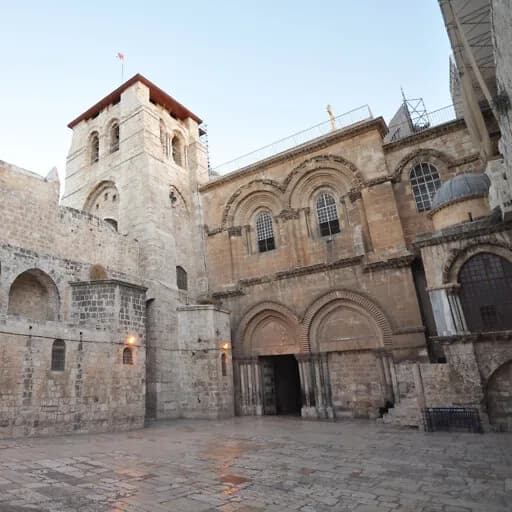
Golgotha is a hill mentioned in 4 verses across 4 books of the Bible. Known today as Church of the Holy Sepulchre.
Verses
4
Books
4
Confidence
Moderate
Coordinates
31.7784, 35.2298
Map
Loading map...
Key Verses About Golgotha
“The place of a skull.”Matthew 27:33 (KJV)
“which is”Mark 15:22 (KJV)
“they crucified him there with the criminals”Luke 23:33 (KJV)
“bearing his cross”John 19:17 (KJV)
What Does “Golgotha” Mean?
What the Commentators Say
“**Verses 31-34** Christ was led as a Lamb to the slaughter, as a Sacrifice to the altar. Even the mercies of the wicked are really cruel. Taking the cross from him, they compelled one Simon to bear it. Make us ready, O Lord, to bear the cross thou hast appointed us, and daily to take it up with cheerfulness, following thee. Was ever sorrow like unto his sorrow? And when we behold what manner of death he died, let us in that behold with what manner of love he loved us. As if death, so painful a death, were not enough, they added to its bitterness and terror in several ways.”
Matthew Henry's Concise Commentary on Matthew 27:33
“(33) **A place called Golgotha.**—The other Gospels give the name with the definite article, as though it were a well-known locality. It is not mentioned, however, by any Jewish writer, and its position is matter of conjecture. It was “nigh unto the city” (John 19:20), and therefore outside the walls (comp. Hebrews 13:12). There was a garden in it (John 19:41), and in the garden a tomb, which was the property of Joseph of Arimathæa (Matthew 27:60). A tradition, traceable to the fourth century, has identified the spot with the building known as the Church of the Sepulchre. One eminent archaeologist of our own time (Mr. James Fergusson) identifies it with the Dome of the Rock in the Mosque of El Aksa. Both sites were then outside the city, but were afterwards enclosed by the third wall, built by Agrippa II. The name has been supposed by some to point to its being a common place of execution; but it is not probable that the skulls of criminals would have been left unburied, nor that a wealthy Jew should have chosen such a spot for a garden and a burial-place. The facts lead rather to the conclusion (1) that the name indicated the round, bare, skull-like character of the eminence which was so called; and (2) that it may have been chosen by the priests as a deliberate insult to the member of their own body who had refused to share their policy, and was at least suspected of discipleship, and whose garden, or orchard, with its rock-hewn sepulchre, lay hard by (Mark 15:43; Luke 23:51; John 19:38). A later legend saw in the name a token that the bones of Adam were buried there, and that as the blood flowed from the sacred wounds on his skull his soul was translated to Paradise. The more familiar name of Calvary (Luke 23:35) has its origin in the Vulgate rendering (*Calvarium=&* skull) of the Greek word *Kranion,* or *Cranium,* which the Evangelist actually uses.”
Ellicott's Commentary for English Readers on Matthew 27:33
Bible Verses Mentioning Golgotha
Learn More
Nearby Biblical Places
Related Resources
Attribution
- Geographic data from OpenBible.info Bible Geocoding Data licensed under CC BY 4.0.
- Map tiles by OpenStreetMap contributors (ODbL 1.0).
- Image: Jorge Láscar.