Biblical Structure
Gabbatha in the Bible
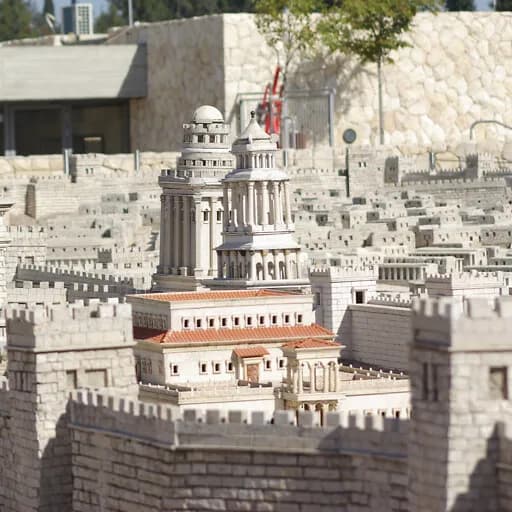
Gabbatha is a structure mentioned in 1 verse across 1 book of the Bible. Known today as Herod’s palace in Jerusalem.
Verses
1
Books
1
Confidence
High
Coordinates
31.7761, 35.2280
Map
Loading map...
Key Verses About Gabbatha
“he brought Jesus out”John 19:13 (KJV)
What Does “Gabbatha” Mean?
What the Commentators Say
“Chapter 19 Chapter Outline Christ condemned and crucified.(1-18) Christ on the cross.(19-30) His side pierced.(31-37) The burial of Jesus.(38-42) **Verses 1-18** Little did Pilate think with what holy regard these sufferings of Christ would, in after-ages, be thought upon and spoken of by the best and greatest of men. Our Lord Jesus came forth, willing to be exposed to their scorn. It is good for every one with faith, to behold Christ Jesus in his sufferings. Behold him, and love him; be still looking unto Jesus. Did their hatred sharpen their endeavours against him? and shall not our love for him quicken our endeavours for him and his kingdom? Pilate seems to have thought that Jesus might be some person above the common order. Even natural conscience makes men afraid of being found fighting against God. As our Lord suffered for the sins both of Jews and Gentiles, it was a special part of the counsel of Divine Wisdom, that the Jews should first purpose his death, and the Gentiles carry that purpose into effect. Had not Christ been thus rejected of men, we had been for ever rejected of God. Now was the Son of man delivered into the hands of wicked and unreasonable men. He was led forth for us, that we might escape. He was nailed to the cross, as a Sacrifice bound to the altar. The Scripture was fulfilled; he did not die at the altar among the sacrifices, but among criminals sacrificed to public justice. And now let us pause, and with faith look upon Jesus. Was ever sorrow like unto his sorrow? See him bleeding, see him dying, see him and love him! love him, and live to him!”
Matthew Henry's Concise Commentary on John 19:13
“(13) **When Pilate therefore heard that saying.**—Better . . . *these sayings*—*i.e.,* the two sayings of the previous verse. **He brought Jesus forth** ., .—Comp. John 19:9. He hesitates no longer about the course to be taken. His own position and life may be in danger, and he prepares, therefore, to pronounce the final sentence, which must necessarily be done from the public judgment seat outside the palace. (Comp. Matthew 27:19.) **The Pavement, but in the Hebrew, Gabbatha.**—Both these words occur here only, and are instances of the writer’s minute knowledge of the localities in Jerusalem. It may have been better to have preserved the Greek name (*Lithostrōton*)*,* as well as that by which the place was known in the Hebrew (Syro-Chaldaic) of the time. The word literally means “stone-paved,” and was the Greek name for the tesselated “pavement” of marble and coloured stones with which from the time of Sylla the Romans delighted to adorn the Prætorium. The Chaldee word means “an elevated place,” so that the one name was given to it from its *form,* and the other from the material of which it was made. Suetonius (*Life,* chap. 46) tells us that Julius Cæsar carried about with him such pieces of marble and stone, but the mention of the *“*place” bears the impression that it was a fixture in front of the Prætorium at Jerusalem, in which the Bema was placed; or it may have been a portion of the northern court of the sanctuary to which Pilate came out, if we identify the Prætorium with the tower Antonia. (Comp. Note on Matthew 27:27.) Josephus mentions that the whole of the Temple mountain was paved with this kind of Mosaic work (*Ant* v. 5. 2. Caspari, *Chron. Geogr., Introd.,* Eng. Trans., p. 225).”
Ellicott's Commentary for English Readers on John 19:13
Bible Verses Mentioning Gabbatha
Learn More
Nearby Biblical Places
Related Resources
Attribution
- Geographic data from OpenBible.info Bible Geocoding Data licensed under CC BY 4.0.
- Map tiles by OpenStreetMap contributors (ODbL 1.0).
- Image: Berthold Werner.