Biblical Settlement
Capernaum in the Bible
Capernaum is a settlement mentioned in 18 verses across 4 books of the Bible. Known today as Tell Hum.
Verses
18
Books
4
Confidence
Very High
Coordinates
32.8811, 35.5750
Map
Loading map...
Key Verses About Capernaum
“he came and lived in Capernaum”Matthew 4:13 (KJV)
“a centurion came to him”Matthew 8:5 (KJV)
“Capernaum”Matthew 11:23 (KJV)
“those who collected the didrachma coins{A didrachma is a Greek silver coin worth 2 drachmas”Matthew 17:24 (KJV)
“and immediately on the Sabbath day he entered into the synagogue and taught.”Mark 1:21 (KJV)
What Does “Capernaum” Mean?
Καπερναούμ (Kapernaoúm, Greek)
Capernaum (i.e. Caphanachum), a place in Palestine
G2584 in Strong's Concordance →What the Commentators Say
“**Verses 12-17** It is just with God to take the gospel and the means of grace, from those that slight them and thrust them away. Christ will not stay long where he is not welcome. Those who are without Christ, are in the dark. They were sitting in this condition, a contented posture; they chose it rather than light; they were willingly ignorant. When the gospel comes, light comes; when it comes to any place, when it comes to any soul, it makes day there. Light discovers and directs; so does the gospel. The doctrine of repentance is right gospel doctrine. Not only the austere John Baptist, but the gracious Jesus, preached repentance. There is still the same reason to do so. The kingdom of heaven was not reckoned to be fully come, till the pouring out of the Holy Spirit after Christ's ascension.”
Matthew Henry's Concise Commentary on Matthew 4:13
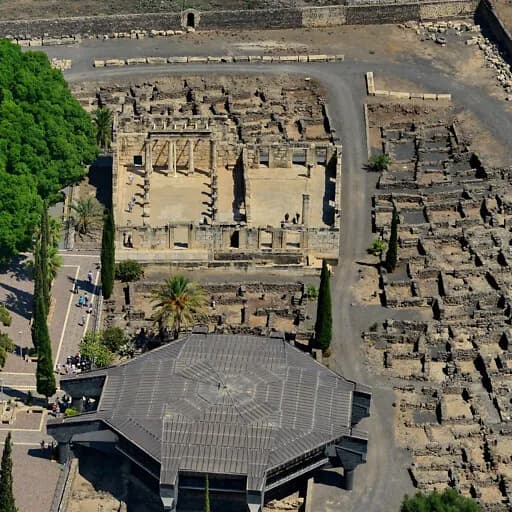
“(13) **Leaving Nazareth.**—The form of the name in the older MSS. is Nazara. St. Matthew records the bare fact. St. Luke (Luke 4:16-30) connects it with His rejection by the men of this very place, where He had been brought up, and their attempt upon His life. St. John (John 2:12) states a fact which implies (1) that Capernaum had not been before the home of the mother of our Lord and of His brethren, and (2) that there were ties of some kind drawing them thither for a temporary visit. The reasons for the choice of that city lie, some of them, on the surface. (1.) The exact site of Capernaum has long been one of the vexed questions of the topography of Palestine, but the researches of the Palestine Exploration Society have identified it with the modern village of *Tell-Hûm,* where their excavations have disinterred the remains of an ancient building of the Roman period, which is supposed to have been the synagogue of the city; possibly, therefore, the very synagogue, built by the believing centurion (Luke 7:5), in which our Lord worshipped and taught (John 6:59). Its position on the shore of the lake, as a town with a garrison and a custom-house, made it the natural centre of the fishing-trade of the Lake of Galilee. As such, it fell in with the habits of the four first-called disciples, who, though two of them were of Bethsaida, were already partly domiciled there. (2.) It was within an easy day’s journey of Nazareth, and so admitted either of another visit thither, as if to see whether those who dwelt there were more capable of faith than they had shown themselves at first (Matthew 13:54), or, as in Matthew 12:46-50, of visits from His mother, and His brethren, when they were anxious to restrain Him from teaching that seemed to them perilous. (3.) Even the presence of the “publicans and sinners”—the latter term including Gentiles, the class of those who had flocked to the preaching of John, and were to be found in the half-Romanised city, and were not to be found in the more secluded villages—may have been one of the elements which led to the decisive choice. (4.) Lastly, St. John’s narrative supplies another link. The healing of the son of one of the Tetrarch’s officers at Capernaum (John 4:46-54) had secured there a certain degree of protection and of influence. The chronology of John 5:1 is uncertain (see Notes there), but at some time before, or shortly after, this migration to Capernaum, we must place the visit to Jerusalem, and the miracle at Bethesda, which St. John there records.”
Ellicott's Commentary for English Readers on Matthew 4:13
Bible Verses Mentioning Capernaum
Learn More
Nearby Biblical Places
Related Resources
Attribution
- Geographic data from OpenBible.info Bible Geocoding Data licensed under CC BY 4.0.
- Map tiles by OpenStreetMap contributors (ODbL 1.0).
- Image: AVRAMGR.