Biblical Settlement
Syene in the Bible
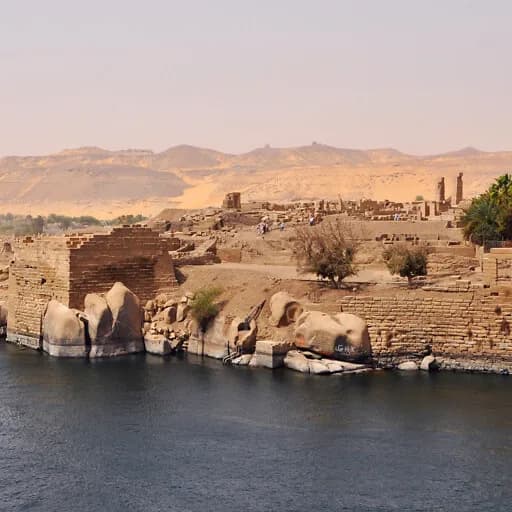
Syene is a settlement mentioned in 3 verses across 2 books of the Bible. Known today as Aswan.
Verses
3
Books
2
Confidence
Very High
Coordinates
24.0889, 32.8997
Map
Loading map...
Key Verses About Syene
“these shall come from far; and behold”Isaiah 49:12 (KJV)
“behold”Ezekiel 29:10 (KJV)
“says the Lord Yahweh.”Ezekiel 30:6 (KJV)
What Does “Syene” Mean?
סְוֵנֵה (Çᵉvênêh, Hebrew) — “her veiling (?)”
Seven, a place in Upper Egypt
H5482 in Strong's Concordance →What the Commentators Say
“Chapter 30 Troubles which shall be before the restoration of Israel. (Jr 30:1-11) Encouragement to trust Divine promises. (Jr 30:12-17) The blessings under Christ, and the wrath on the wicked. (Jr 30:18-24) **Verses 1-11** Jeremiah is to write what God had spoken to him. The very words are such as the Holy Ghost teaches. These are the words God ordered to be written; and promises written by his order, are truly his word. He must write a description of the trouble the people were now in, and were likely to be in. A happy end should be put to these calamities. Though the afflictions of the church may last long, they shall not last always. The Jews shall be restored again. They shall obey, or hearken to the Messiah, the Christ, the Son of David, their King. The deliverance of the Jews from Babylon, is pointed out in the prophecy, but the restoration and happy state of Israel and Judah, when converted to Christ their King, are foretold; also the miseries of the nations before the coming of Christ. All men must honour the Son as they honour the Father, and come into the service and worship of God by him. Our gracious Lord pardons the sins of the believer, and breaks off the yoke of sin and Satan, that he may serve God without fear, in righteousness and true holiness before him all the remainder of his days, as the redeemed subject of Christ our King.”
Matthew Henry's Concise Commentary on Ezekiel 30:6
“(12) F**rom the west.**—Literally, *from the sea, *which commonly has this meaning. In Psalm 107:3, however, it clearly stands for the south, and is probably used in that sense here. In this case “from far” stands for the south, probably for the distant Ethiopia, where Jewish exiles had already found their way (Zephaniah 3:10). **From the land of Sinim.**—The region thus named is clearly the *ultima Thule *of the prophet’s horizon, and this excludes the “Sinites” of Canaan (Genesis 10:17), and the Sin (Pelusium) of Egypt. Modern scholars are almost unanimous in making it refer to the Chinese. Phœnician or Babylonian commerce may have made that people known, at least by name, to the prophet. Recent Chinese researches have brought to light traditions that in B.C. 2353 (and again in B.C. 1110) a people came from a strange western land, bringing with them a tortoise, on the shell of which was a history of the world, in strange characters “like tadpoles.” It is inferred that this was a cuneiform inscription, and the theory has been recently maintained that this was the origin of the present Chinese mode of writing. (See Cheyne’s “Excursus,” 2 p. 20, and an elaborate article on “China and Assyria” in the *Quarterly Review *for October, 1882.) Porcelain with Chinese characters has been found, it may be added, in the ruins of the Egyptian Thebes (Wilkinson, *Ancient Egyptians, *1st ser., iii. 106-109). All recent discoveries tend to the conclusion that the commerce of the great ancient monarchies was wider than scholars of the sixteenth century imagined. The actual immigration of Jews into China is believed to have taken place about B.C. 200 (Delitzsch *in loc*)*.*”
Ellicott's Commentary for English Readers on Isaiah 49:12
Bible Verses Mentioning Syene
Learn More
Nearby Biblical Places
Related Resources
Attribution
- Geographic data from OpenBible.info Bible Geocoding Data licensed under CC BY 4.0.
- Map tiles by OpenStreetMap contributors (ODbL 1.0).
- Image: Marc Ryckaert.