Biblical Settlement
Nazareth in the Bible
Nazareth is a settlement mentioned in 32 verses across 5 books of the Bible.
Verses
32
Books
5
Confidence
Very High
Coordinates
32.7021, 35.2977
Map
Loading map...
Key Verses About Nazareth
“And he came and dwelt in a city called Nazareth: that it might be fulfilled which was spoken by the prophets”Matthew 2:23 (KJV)
“he came and lived in Capernaum”Matthew 4:13 (KJV)
“he taught them in their synagogue”Matthew 13:54 (KJV)
“This is the prophet, Jesus, from Nazareth of Galilee.”Matthew 21:11 (KJV)
“someone else saw him”Matthew 26:71 (KJV)
What Does “Nazareth” Mean?
What the Commentators Say
“**Verses 19-23** Egypt may serve to sojourn in, or take shelter in, for awhile, but not to abide in. Christ was sent to the lost sheep of the house of Israel, to them he must return. Did we but look upon the world as our Egypt, the place of our bondage and banishment, and heaven only as our Canaan, our home, our rest, we should as readily arise and depart thither, when we are called for, as Joseph did out of Egypt. The family must settle in Galilee. Nazareth was a place held in bad esteem, and Christ was crucified with this accusation, Jesus the Nazarene. Wherever Providence allots the bounds of our habitation, we must expect to share the reproach of Christ; yet we may glory in being called by his name, sure that if we suffer with him, we shall also be glorified with him.”
Matthew Henry's Concise Commentary on Matthew 2:23
“(23) **He shall be called a Nazarene.**—For an account of Nazareth, see Note on Luke 1:26. Here it will be enough to deal with St. Matthew’s reference to the name as in itself the fulfilment of a prophetic thought. He does not, as before, cite the words of any one prophet by name, but says generally that what he quotes had been spoken by or through the prophets. No such words are to be found in the Old Testament. It is not likely that the Evangelist would have quoted from any apocryphal prophecy, nor is there any trace of the existence of such a prophecy. The true explanation is to be found in the impression made on his mind by the verbal coincidence of fact with prediction. He had heard men speak with scorn of “the Nazarene,” and yet the very syllables of that word had also fallen on his ears in one of the most glorious of the prophecies admitted to be Messianic—“There shall come forth a rod out of the stem of Jesse, and a *Netzer* (Branch) shall grow out of his roots” (Isaiah 11:1). So he found in the word of scorn the *nomen et omen* of glory. The town of Nazareth probably took its name from this meaning of the word, as pointing, like our *-hurst* and *-holt,* to the trees and shrubs for which it was conspicuous. The general reference to the prophets is explained by the fact that the same thought is expressed in Jeremiah 23:5; Jeremiah 33:15; Zechariah 3:8; Zechariah 6:12, though there the Hebrew word is *Zemach,* and not *Netzer.* A like train of thought is found in the language of Tertullian and other early Christian writers to their heathen opponents—“You call us Christians,” they say,” worshippers of Christos, but you pronounce the words *Chrestiani* and *Chrestos, i.e.,* you give us a name which in your own language (Greek) means ‘good,’ and so you unconsciously bear testimony to the life we really lead.” This seems the only tenable explanation of the passage. It is hardly likely that the Evangelist should have referred to the scorn with which Nazareth was regarded. Any reference to the Nazarite vow is out of the question, (1) because the two words are spelt differently, both in Greek and Hebrew, and (2) because our Lord’s life represented quite a different aspect of holiness from that of which the Nazarite vow was the expression. That vow, as seen pre-eminently in the Baptist, represented the consecration which consists in separation from the world. The life of Christ manifested the higher form of consecration which is found in being *in* the world but not *of* it, mingling with the men and women who compose it, in order to purify and save. **Ellicott's Commentary for English Readers Text Courtesy of BibleSupport.com. Used by Permission. **Bible Hub”
Ellicott's Commentary for English Readers on Matthew 2:23
Bible Verses Mentioning Nazareth
Learn More
Nearby Biblical Places
Related Resources
Attribution
- Geographic data from OpenBible.info Bible Geocoding Data licensed under CC BY 4.0.
- Map tiles by OpenStreetMap contributors (ODbL 1.0).
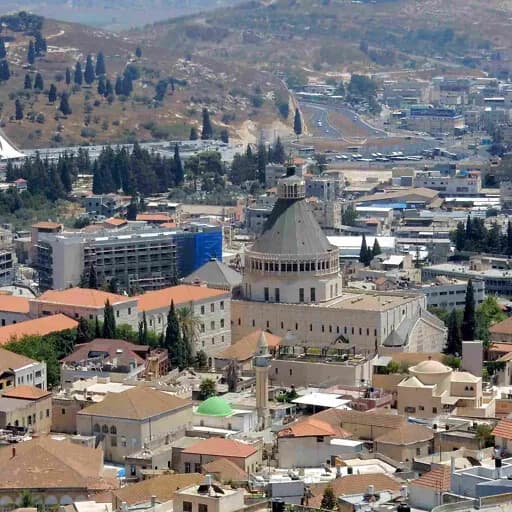
- Image: FLASHPACKER TRAVELGUIDE.