Biblical Settlement
Caesarea Philippi in the Bible
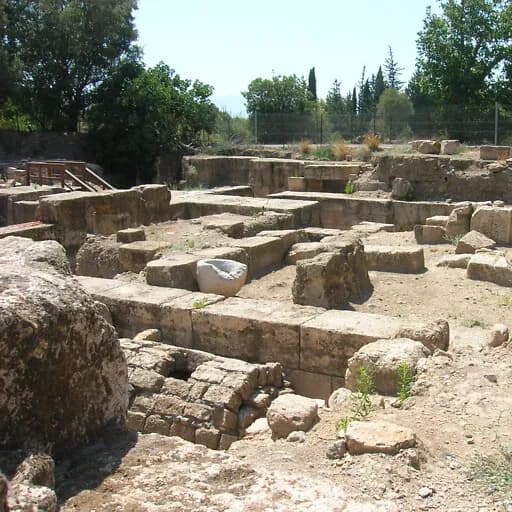
Caesarea Philippi is a settlement mentioned in 2 verses across 2 books of the Bible. Known today as Banias.
Verses
2
Books
2
Confidence
Very High
Coordinates
33.2461, 35.6933
Map
Loading map...
Key Verses About Caesarea Philippi
“he asked his disciples”Matthew 16:13 (KJV)
“with his disciples”Mark 8:27 (KJV)
What the Commentators Say
“**Verses 13-20** Peter, for himself and his brethren, said that they were assured of our Lord's being the promised Messiah, the Son of the living God. This showed that they believed Jesus to be more than man. Our Lord declared Peter to be blessed, as the teaching of God made him differ from his unbelieving countrymen. Christ added that he had named him Peter, in allusion to his stability or firmness in professing the truth. The word translated "rock," is not the same word as Peter, but is of a similar meaning. Nothing can be more wrong than to suppose that Christ meant the person of Peter was the rock. Without doubt Christ himself is the Rock, the tried foundation of the church; and woe to him that attempts to lay any other! Peter's confession is this rock as to doctrine. If Jesus be not the Christ, those that own him are not of the church, but deceivers and deceived. Our Lord next declared the authority with which Peter would be invested. He spoke in the name of his brethren, and this related to them as well as to him. They had no certain knowledge of the characters of men, and were liable to mistakes and sins in their own conduct; but they were kept from error in stating the way of acceptance and salvation, the rule of obedience, the believer's character and experience, and the final doom of unbelievers and hypocrites. In such matters their decision was right, and it was confirmed in heaven. But all pretensions of any man, either to absolve or retain men's sins, are blasphemous and absurd. None can forgive sins but God only. And this binding and loosing, in the common language of the Jews, signified to forbid and to allow, or to teach what is lawful or unlawful.”
Matthew Henry's Concise Commentary on Matthew 16:13
“(13) **Cæsarea Philippi.**—The order of the journeyings of our Lord and His disciples would seem to have been as follows:—From the coasts of Tyre and Sidon they came, passing through Sidon, to the eastern shore of the Sea of Galilee (Mark 7:31); thence by ship to Magdala and Dalmanutha, on the western shore (Matthew 15:39; Mark 8:10); thence, again crossing the lake (Mark 8:13), to the eastern Bethsaida (Mark 8:22); thence to Cæsarea Philippi. There is in all these movements an obvious withdrawal from the populous cities which had been the scene of His earlier labours, and which had practically rejected Him and cast in their lot with His enemies. This last journey took them to a district which He had apparently never before visited, and to which He now came, it would seem, not as a Preacher of the kingdom, but simply for retirement and perhaps for safety. Cæsarea Philippi (so called to distinguish it from the town of the same name on the sea-coast) does not appear (unless we identify it with Laish or Dan, and for this there is no sufficient evidence) in the history of the Old Testament. Its position at the foot of Hermon led Robinson (*Researches,* iii. 404, 519) to identify it with the Baal-gad of Joshua 11:17; Joshua 12:7; Joshua 13:5, or the Baal-hermon of Judges 3:3; but this also hardly extends beyond the region of conjecture. The site of the city was near the chief source of the Jordan, which flowed from a cave which, under the influence of the Greek *cultus* that came in with the rule of the Syrian kings, was dedicated to Pan, and the old name of the city, Paneas, bore witness to this consecration. Herod the Great built a temple there in honour of Augustus (Jos. *Ant.* xv. 10, § 3), and his son Philip the tetrarch (to whose province it belonged) enlarged and embellished the city, and re-named it in honour of the emperor and to perpetuate his own memory. From Agrippa II. it received the name of Neroneas, as a like compliment to the emperor to whom he owed his title; but the old local name survived these passing changes, and still exists in the modern Bâiâs. With the one exception of the journey through Sidon (Mark 7:31), it was the northern limit of our Lord’s wanderings; and belonging as it does to the same period of His ministry, His visit to it may be regarded, though not as an extension of His work beyond its self-imposed limits, as indicating something like a sympathy with the out-lying heathen who made up the bulk of its population—a sense of rest, it may be, in turning to them from the ceaseless strife and bitterness which He encountered at Capernaum and Jerusalem. How the days passed which were spent on the journey, what gracious words or acts of mercy marked His track, what communings with His Father were held in the solitude of the mountain heights—are questions which we may dwell upon in reverential silence, but must be content to leave unanswered. The incident which follows is the one event of which we have any record. **Whom do men say that I the Son of man am**?—The Greek emphasises “men” by prefixing the article, so as to contrast the opinions of men, as such, with God’s revelation. The question comes before us, as possibly it did to the disciples, with a sharp abruptness. We may believe, however, that it occupied a fitting place in the spiritual education through which our Lord was leading His disciples. It was a time of, at least, seeming failure and partial desertion. “From that time,” St. John relates, speaking of what followed after the discourse at Capernaum, “many of His disciples went back, and walked no more with Him” (John 6:66)*.* He had turned to the Twelve and asked, in tones of touching sadness, “Will ye also go away?” and had received from Peter, as the spokesman of the others, what was for the time a reassuring answer, “Lord, to whom shall we go? Thou hast the words of eternal life;” and this had been coupled with the confession of faith which we now find repeated. But in the meantime there had been signs of wavering. He had had to rebuke them as being “of little faith” (Matthew 16:8). They had urged something like a policy of reticence in His conflict with the Pharisees (Matthew 15:12). One of the Twelve was cherishing in his soul the “devil-temper” of a betrayer (John 6:70). It was time, if we may so speak, that they should be put to a crucial test, and the alternative of faith or want of faith pressed home upon their consciences.”
Ellicott's Commentary for English Readers on Matthew 16:13
Bible Verses Mentioning Caesarea Philippi
Learn More
Nearby Biblical Places
Related Resources
Attribution
- Geographic data from OpenBible.info Bible Geocoding Data licensed under CC BY 4.0.
- Map tiles by OpenStreetMap contributors (ODbL 1.0).
- Image: EdoM.