Biblical Settlement
Athens in the Bible
Athens is a settlement mentioned in 6 verses across 2 books of the Bible.
Verses
6
Books
2
Confidence
Very High
Coordinates
37.9719, 23.7267
Map
Loading map...
Key Verses About Athens
“they departed.”Acts 17:15 (KJV)
“his spirit was provoked within him as he saw the city full of idols.”Acts 17:16 (KJV)
“but either to tell or to hear some new thing.”Acts 17:21 (KJV)
“and said”Acts 17:22 (KJV)
“and came to Corinth.”Acts 18:1 (KJV)
What Does “Athens” Mean?
What the Commentators Say
“**Verses 10-15** The Jews in Berea applied seriously to the study of the word preached unto them. They not only heard Paul preach on the sabbath, but daily searched the Scriptures, and compared what they read with the facts related to them. The doctrine of Christ does not fear inquiry; advocates for his cause desire no more than that people will fully and fairly examine whether things are so or not. Those are truly noble, and likely to be more and more so, who make the Scriptures their rule, and consult them accordingly. May all the hearers of the gospel become like those of Berea, receiving the word with readiness of mind, and searching the Scriptures daily, whether the things preached to them are so.”
Matthew Henry's Concise Commentary on Acts 17:15
“(16) **His spirit was stirred** **in him.**—The verb is the root of the noun from which we get our “paroxysm,” and which is translated by “sharp contention” in Acts 15:39. Athens, glorying now, as it had done in the days of Sophocles (*Œdip. Col.* 1008), in its devotion to the gods, presented to him, even after seeing Tarsus and Antioch, a new aspect. The city was “full of idols;” Hermes-busts at every corner, statues and altars in the *atrium* or court-yard of every house, temples and porticos and colonnades, all presenting what was to him the same repulsive spectacle. He looked on the Theseus and the Ilissus, and the friezes of the Centaurs and Lapithæ on the Parthenon, as we look on them in our museums, but any sense of art-beauty which he may have had (and it was probably, in any case, but weak) was over-powered by his horror that men should bow down and worship what their own hands had made. The beauty of form which we admire in the Apollo or the Aphrodite, the Mercury or the Faun, would be to him, in its unveiled nakedness, a thing to shudder at. He knew too well to what that love of sensuous beauty had led in Greek and Roman life (Romans 1:24-27), when it had thrown aside what, to a Jew, were not only the natural instincts of purity, but the sanctions of a divine command (Genesis 9:22).”
Ellicott's Commentary for English Readers on Acts 17:16
Bible Verses Mentioning Athens
Learn More
Nearby Biblical Places
Related Resources
Attribution
- Geographic data from OpenBible.info Bible Geocoding Data licensed under CC BY 4.0.
- Map tiles by OpenStreetMap contributors (ODbL 1.0).
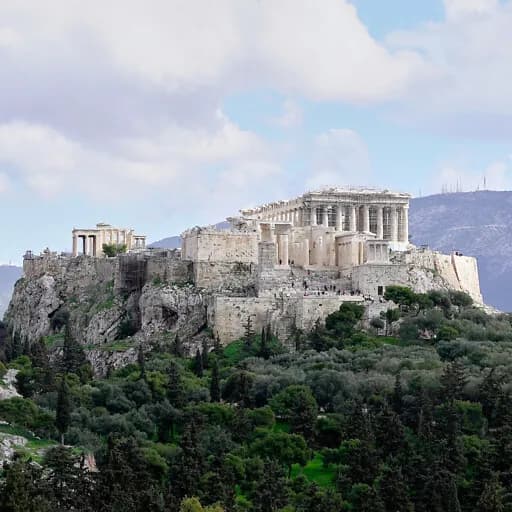
- Image: George E. Koronaios.