Biblical Settlement
Philippi in the Bible
Philippi is a settlement mentioned in 4 verses across 3 books of the Bible.
Verses
4
Books
3
Confidence
Very High
Coordinates
41.0121, 24.2846
Map
Loading map...
Key Verses About Philippi
“which is a city of Macedonia”Acts 16:12 (KJV)
“and came to them at Troas in five days”Acts 20:6 (KJV)
“servants of Jesus Christ; To all the saints in Christ Jesus who are at Philippi”Philippians 1:1 (KJV)
“as you know”1 Thessalonians 2:2 (KJV)
What Does “Philippi” Mean?
What the Commentators Say
“**Verses 6-15** The removals of ministers, and the dispensing the means of grace by them, are in particular under Divine conduct and direction. We must follow Providence: and whatever we seek to do, if that suffer us not, we ought to submit and believe to be for the best. People greatly need help for their souls, it is their duty to look out for it, and to invite those among them who can help them. And God's calls must be complied with readily. A solemn assembly the worshippers of God must have, if possible, upon the sabbath day. If we have not synagogues, we must be thankful for more private places, and resort to them; not forsaking the assembling together, as our opportunities are. Among the hearers of Paul was a woman, named Lydia. She had an honest calling, which the historian notices to her praise. Yet though she had a calling to mind, she found time to improve advantages for her soul. It will not excuse us from religious duties, to say, We have a trade to mind; for have not we also a God to serve, and souls to look after? Religion does not call us from our business in the world, but directs us in it. Pride, prejudice, and sin shut out the truths of God, till his grace makes way for them into the understanding and affections; and the Lord alone can open the heart to receive and believe his word. We must believe in Jesus Christ; there is no coming to God as a Father, but by the Son as Mediator.”
Matthew Henry's Concise Commentary on Acts 16:12
“(12) **The chief city of that part of Macedonia.**—More accurately, *a chief* (or *first*)* city of the border-country of Macedonia.* The description is not without difficulty, and has been noted by adverse critics as an instance of St. Luke’s inaccuracy. The city of Philippi, rebuilt by the father of Alexander the Great, and bearing his name in lieu of Krenides ( = the fountains), was situated on the Gangites, a tributary of the Strymon; but it was not the chief city of any one of the four sub-divisions of the Roman province of Macedonia, that rank being assigned to Amphipolis, Thessalonica, Pella, and Pelagonia. As there is no definite article in the Greek, it is possible that St. Luke simply meant to say it was *a* chief town of the district, the epithet *Prôte* ( = first) being often found on the coins of cities which were not capitals. The more probable explanation, however, is that he uses the Greek word translated “part,” in the sense of “border-land,” as in the LXX. of Ezekiel 35:7, Ruth 3:7, and that it was the *first* city of that frontier district, either as the most important or as being the first to which they came in the route by which they travelled. This was precisely the position of Philippi, which, together with Pella and other towns, had been garrisoned by the Romans as outposts against the neighbouring tribes of Thrace. It had been established as a colony by Augustus after the defeat of Brutus and Cassius, and its full title, as seen on the coins of the city, was Colonia Augusta Julia Philippensis. **A colony.**—The English reader needs to be reminded that a Roman *colonia* differed from the modern in being essentially a military position. Portions of the conquered territory were commonly assigned to veteran soldiers, and the settlement thus formed was considered politically as an integral part of Rome, all decrees of the emperor or senate being as binding there as in the capital itself. The colonies thus formed were as the “propugnacula imperii” (Cic. *de leg. Agrar.* c. 27), “populi Romani quasi effigies parvæ simulacraque” (Aul. Gell. xvi. 13). Here, then, in the first European city to which St. Paul came, there was something like an earnest of his future victories. Himself a Roman citizen, he was brought into direct contact with Romans. (See Note on Acts 16:21.)”
Ellicott's Commentary for English Readers on Acts 16:12
Bible Verses Mentioning Philippi
Learn More
Nearby Biblical Places
Related Resources
Attribution
- Geographic data from OpenBible.info Bible Geocoding Data licensed under CC BY 4.0.
- Map tiles by OpenStreetMap contributors (ODbL 1.0).
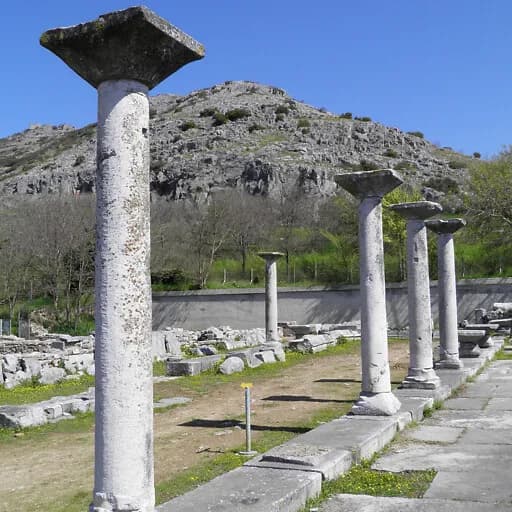
- Image: Carole Raddato.