Biblical Settlement
Heliopolis in the Bible
Heliopolis is a settlement mentioned in 5 verses across 3 books of the Bible. Known today as Ain Shams.
Verses
5
Books
3
Confidence
Very High
Coordinates
30.1294, 31.3075
Map
Loading map...
Key Verses About Heliopolis
“the daughter of Potiphera priest of On as a wife. Joseph went out over the land of Egypt.”Genesis 41:45 (KJV)
“whom Asenath”Genesis 41:50 (KJV)
“whom Asenath”Genesis 46:20 (KJV)
“that is in the land of Egypt; and the houses of the gods of Egypt shall he burn with fire.”Jeremiah 43:13 (KJV)
“The young men of Aven and of Pibeseth shall fall by the sword: and these cities shall go into captivity.”Ezekiel 30:17 (KJV)
What the Commentators Say
“**Verses 33-45** Joseph gave good advice to Pharaoh. Fair warning should always be followed by good counsel. God has in his word told us of a day of trial before us, when we shall need all the grace we can have. Now, therefore, provide accordingly. Pharaoh gave Joseph an honourable testimony. He is a man in whom the spirit of God is; and such men ought to be valued. Pharaoh puts upon Joseph marks of honour. He gave him such a name as spoke the value he had for him, Zaphnath-paaneah, "a revealer of secrets." This preferment of Joseph encourages all to trust in God. Some translate Joseph's new name, "the saviour of the world." The brightest glories, even of the upper world, are put upon Christ, the highest trust lodged in his hand, and all power given him, both in heaven and earth.”
Matthew Henry's Concise Commentary on Genesis 41:45
“(45) **Zaphnath-paaneah.**—This word also is Egyptian, and, fortunately, there is no Hebrew word of similar sound to suggest a false meaning. Canon Cook shows that it means “food of life,” or “food of the living.” The LXX. have *Psonthom-phanek, *which Jerome, on the authority of the Jews in Egypt, translates “saviour of the world.” By “the world,” would be meant the living, as in Canon Cook’s explanation, which, in the sense of “he who feeds the world,” or “the living,” is the best exposition yet given. There is no authority for the supposition that the name means “revealer of secrets.” **Asenath.**—Án Egyptian word signifying the “favourite of Neith,” the Egyptian Minerva. **Potipherah.**—See Note on Genesis 39:1. **On.**—This is also an Egyptian word, signifying the sun, whence in Hebrew the name of this city was Bethshemesh, *house of the sun; *in Greek, Heliopolis; and in Latin, Oppidum Solls. It was famous for its temple of Ra, the sun, destroyed at an early period by the Persians, but still remarkable for its ruins, among which is an obelisk covered with hieroglyphics of extreme antiquity. Several of the obelisks now at Rome were brought by the emperor Caligula from this spot. It is situated about six miles north-east of Cairo. A difficulty has been felt by some in a Hebrew shepherd being thus described as marrying the daughter of a priest of the sun; and also that Joseph, a worshipper of the One God, should ally himself with an idolater. But the elevation of a slave to high rank is not an uncommon occurrence in the East, especially as he might be of as good birth and education as his owner, slaves being obtained either by kidnapping, or by war. And a slave so raised to power, would not be likely to oppose his benefactor, nor would even a high priest refuse a daughter to the king’s favourite, especially if, as appears to have been the case, he had first been raised to the priesthood. Joseph too, would rightly regard the whole matter as providential, and though he might not know for what exact purpose, as regards his race, he was thus exalted, there was noble work for him to do in saving Egypt from perishing by famine. The narrative throughout represents him as remaining true to the religion of his family (Genesis 41:51-52; Genesis 42:18; Genesis 43:29; Genesis 45:5; Genesis 45:7-9; Genesis 48:9; Genesis 1:19-20; Genesis 1:24), but probably, on public occasions he would be required to attend at the religious solemnities of the Egyptian gods. We must remember, however, that their worship had not degenerated as yet into the miserable idolatry of later times, and that the Egyptian creed contained much primæval truth, though in a corrupted form. Pharaoh himself, in Genesis 41:38-39, speaks as one that acknowledged a supreme God, and Joseph throughout freely used to him the name of Elohim. As for Asenath, no doubt Joseph would teach her higher views of the Deity, and make her acquainted with the religious hopes and destinies of the Abrahamic race. The possibility, however, of a foreigner attaining to high rank in Egypt, is demonstrated by the story of Saneha, translated in *Records of the Past, *vol. vi., pp. 131-150. It belongs to the reign of Amenemha I., a king of the twelfth dynasty, and represents Saneha as entering Egypt in the dress of a herbseller, but in time he marries there the eldest daughter of a local king, has a large landed estate given him, “which abounded in wines more than in water,” and, finally, is sent for by King Amenemha, and raised to such high rank, as to be clad in “garments of kingly attire,” and on his going to the royal palace “the king’s children attend him, proceeding even unto the great gates.” This curious evidence, which is even a little older than the time of Joseph, proves that there is nothing unusual or improbable in his exaltation.”
Ellicott's Commentary for English Readers on Genesis 41:45
People Connected to Heliopolis
Bible Verses Mentioning Heliopolis
Learn More
Nearby Biblical Places
Related Resources
Attribution
- Geographic data from OpenBible.info Bible Geocoding Data licensed under CC BY 4.0.
- Map tiles by OpenStreetMap contributors (ODbL 1.0).
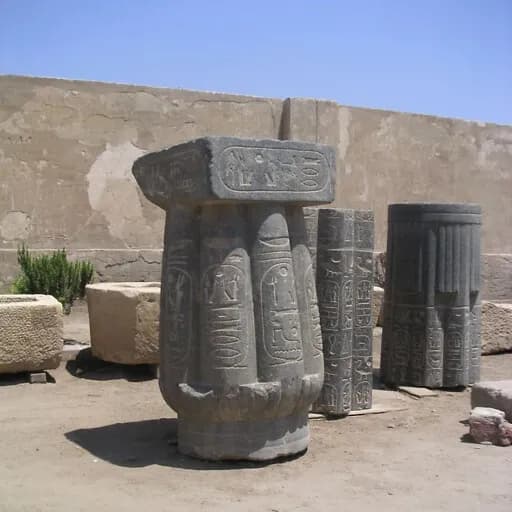
- Image: Neithsabes.