Biblical Special Place
Hara in the Bible
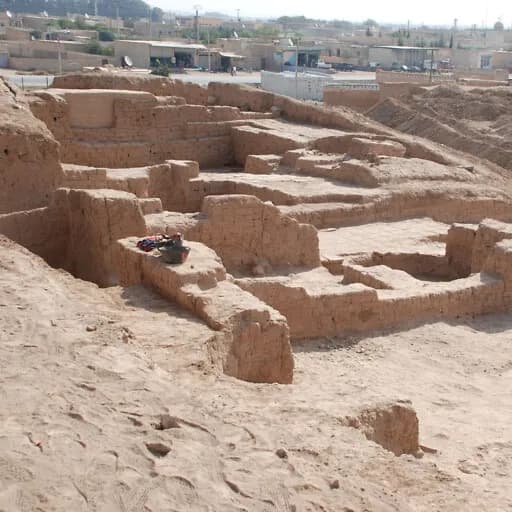
Hara is a special place mentioned in 1 verse across 1 book of the Bible. Known today as Tell Halaf.
Verses
1
Books
1
Confidence
Low
Coordinates
36.8268, 40.0397
Map
Loading map...
Key Verses About Hara
“and the spirit of Tilgath Pilneser king of Assyria”1 Chronicles 5:26 (KJV)
What Does “Hara” Mean?
What the Commentators Say
“Chapter 5 Genealogies. --This chapter gives some account of the two tribes and a half seated on the east side of Jordan. They were made captives by the king of Assyria, because they had forsaken the Lord. Only two things are here recorded concerning these tribes. 1. They all shared in a victory. Happy is that people who live in harmony together, who assist each other against the common enemies of their souls, trusting in the Lord, and calling upon him. 2. They shared in captivity. They would have the best land, not considering that it lay most exposed. The desire of earthly objects draws to a distance from God's ordinances, and prepares men for destruction.”
Matthew Henry's Concise Commentary on 1 Chronicles 5:26
“(26) **Stirred up** (or woke) **the spirit.**—So 2Chronicles 21:16, and Ezra 1:1; Ezra 1:5. For the thought, Isaiah 44:28; Isaiah 45:1-13. **Pul king of Assyria, and . . . Tilgath-pilneser king of Assyria.**—No trace of Pûl as distinct from Tiglath-pileser has been found in the Assyrian monuments, which, it must be remembered, are contemporary. In 2Kings 15:19 we read that, “Pul king of Assyria came against the land,” in the reign of Menahem, who recognised the Assyrian monarch as his suzerain, and paid a tribute of 1,000 talents of silver. Now Tiglath-pileser II. actually claims to have received tribute of Menahem (*Menahimmu*)*.* Pûl appears to have been the original name of Tiglath-pileser, which, upon his accession to the throne of Assyria (745 B.C.), he discarded for that of the great king who had ruled the country four centuries before his time. The name Pûl has been identified by Dr. Schrader with the Porus of Ptolemy’s Canon, *Pôr* being the Persian pronunciation of Pûl. The Syriac here omits “Pûl king of Assyria.” The LXX. (Vat.) has Χαλαχ, and the Arabic *Bãlaq.* Perhaps the chronicler meant to indicate the identity of Pûl and Tiglath: “The spirit of Pul *and *(*=* that is) the spirit of Tiglath, and *he* carried them away.” **And he carried them away.**—Tiglath-pileser is meant. (See 2Kings 15:29 : “In the days of Pekah king of Israel, came Tiglath-pileser king of Assyria, and took Ijon, and Abel-beth-maachah . . . and *Gilead,* and Galilee . . . and carried them captive to Assyria.”) From the Assyrian records we learn that (*circ.* 734–732 B.C.) Tiglath-pileser received the homage of Ahaz (Yahu-haçi, Jeho-ahaz), king of Judah, slew Rezin (Raçunni) of Damascus, and reduced Pekah (Paqahú), king of Samaria, to vassalage. This supplements the Biblical account. Gilead, in 2Kings 15:29, represents the trans-Jordanic tribes. (See 1Chronicles 5:10; 1Chronicles 5:16 above.) The transportation of entire populations was a common practice with the Assyrian kings. Assurbanipal (Sardanapalus) removed the men of Karbit from the mountains east of Assyria, and settled them in Egypt. **Brought them unto Halah, and Habor . . .**—The same localities are mentioned (2Kings 17:6) as those to which Shalmaneser IV., or rather his successor Sargon, transported the other tribes of the northern kingdom (*circ.* 721 B.C.). There is nothing unlikely in the statement of either text. Sargon might have thought fit to strengthen the Israelite settlements in Northern Assyria by sending thither the new bodies of compulsory colonists. It is arbitrary to suppose that two different events have been confounded by the sacred annalists. **Halah.**—See Note on 2Kings 17:6. **Habor.**—Probably a district of North Assyria, not far from Halah, named after the river *Habūr* which rises near the upper *Zab* and falls into the Tigris. **Hara.**—Kings, *l.c.,* “cities of Media.” Hara here is perhaps an Aramaic name for the Median high lands, but more probably the reading is a relic of “the mountains of Media” *[hārê Mādai*)*;* comp.the LXX. at 2Kings 17:6. The Syriac here has “*cities* of Media;” the LXX. omits the word. **The river Gozan.**—Rather, *the river of Gozan.* Shalmaneser mentions the country Guzana in Mesopotamia, the Greek Gauzanitis. An Assyrian list connects it with *Naçibina* (Nisibis). The “river of Gozan” is the *Habur.* Ellicott's Commentary for English Readers Text Courtesy of BibleSupport.com. Used by Permission. Bible Hub”
Ellicott's Commentary for English Readers on 1 Chronicles 5:26
Bible Verses Mentioning Hara
Nearby Biblical Places
Related Resources
Attribution
- Geographic data from OpenBible.info Bible Geocoding Data licensed under CC BY 4.0.
- Map tiles by OpenStreetMap contributors (ODbL 1.0).
- Image: Bertramz.