Biblical Settlement
Caesarea in the Bible
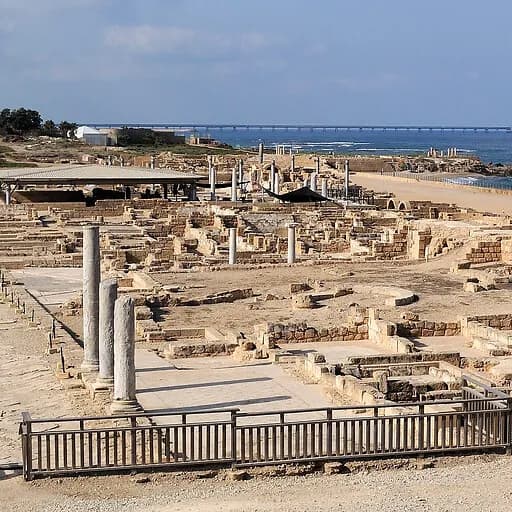
Caesarea is a settlement mentioned in 18 verses across 1 book of the Bible. Known today as Caesarea Maritima.
Verses
18
Books
1
Confidence
Very High
Coordinates
32.5000, 34.8917
Map
Loading map...
Key Verses About Caesarea
“he preached the Good News to all the cities”Acts 8:40 (KJV)
“they brought him down to Caesarea”Acts 9:30 (KJV)
“Cornelius by name”Acts 10:1 (KJV)
“having called together his relatives and his near friends.”Acts 10:24 (KJV)
“immediately three men stood before the house where I was”Acts 11:11 (KJV)
What the Commentators Say
“**Verses 26-40** Philip was directed to go to a desert. Sometimes God opens a door of opportunity to his ministers in very unlikely places. We should study to do good to those we come into company with by travelling. We should not be so shy of all strangers as some affect to be. As to those of whom we know nothing else, we know this, that they have souls. It is wisdom for men of business to redeem time for holy duties; to fill up every minute with something which will turn to a good account. In reading the word of God, we should often pause, to inquire of whom and of what the sacred writers spake; but especially our thoughts should be employed about the Redeemer. The Ethiopian was convinced by the teaching of the Holy Spirit, of the exact fulfilment of the Scripture, was made to understand the nature of the Messiah's kingdom and salvation, and desired to be numbered among the disciples of Christ. Those who seek the truth, and employ their time in searching the Scriptures, will be sure to reap advantages. The avowal of the Ethiopian must be understood as expressing simple reliance on Christ for salvation, and unreserved devotion to Him. Let us not be satisfied till we get faith, as the Ethiopian did, by diligent study of the Holy Scriptures, and the teaching of the Spirit of God; let us not be satisfied till we get it fixed as a principle in our hearts. As soon as he was baptized, the Spirit of God took Philip from him, so that he saw him no more; but this tended to confirm his faith. When the inquirer after salvation becomes acquainted with Jesus and his gospel, he will go on his way rejoicing, and will fill up his station in society, and discharge his duties, from other motives, and in another manner than heretofore. Though baptized in the name of the Father, Son, and Holy Ghost, with water, it is not enough without the baptism of the Holy Ghost. Lord, grant this to every one of us; then shall we go on our way rejoicing.”
Matthew Henry's Concise Commentary on Acts 8:40
“(40) **Philip was** **found at Azotus.**—The city so named, the Ashdod of the Old Testament, was, like Gaza, one of the cities of the Philistines, about three miles from the sea, and half-way between Gaza and Joppa. Like Gaza its history was chiefly marked by successive sieges: by Tartan, the Assyrian General B.C. 716 (Isaiah 20:1); by Psammetichus, B.C. 630, (Herod. ii. 157); the Maccabees (1 Maccabees 5:68; 1 Maccabees 10:34). It was restored by the Roman general Gabinius in B.C. 55. In remoter times it had been one of the headquarters of the worship of Dagon (1Samuel 5:5), The old name lingers in the modern *Esdud, *but the city has sunk into a decayed village. The narrative suggests the thought that here also Philip continued his work as an evangelist. Philistia was, as of old, to be joined with Ethiopia in furnishing the city of God with converts who should be written among the people (Psalm 87:4). **He preached in all the cities.**—The route which Philip would naturally take on this journey led through Lydda and Joppa, and we may probably trace the effect of his labours in the appearance in Acts 9:32; Acts 9:36, of organised and apparently flourishing Christian societies in both these towns. **Till he came to Cæsarea.**—The historical importance of the city, lying on the line of the great road from Tyre to Egypt, dates, as its name shows, from the Roman period. As described by Strabo, it was known only as Strato’s Tower, with a landing place for ships. It rose to magnificence, however, under Herod the Great, who built theatres, amphitheatres, and temples, and constructed a harbour as large as the Piræus at Athens. In honour of his imperial patron he named it *Cæsarea Sebaste* (the latter word meaning *Augusta*) (Jos. *Ant.* xvi. 5, § 1). It became, after the deposition of Archelaus, the official residence of the Roman Procurator, and is, as the sequel shows, prominent in the early history of the Church. Tacitus (*Hist.* ii. 79) speaks of it as the chief city—the *caput* of Judæa. It appears from Acts 21:8 that Philip took up his abode there and made it the head-quarters of his work as an evangelist. In ecclesiastical history it became famous as the scene for a time of the labours of the great Origen, and as the home of the historian-bishop Eusebius. Ellicott's Commentary for English Readers Text Courtesy of BibleSupport.com. Used by Permission. Bible Hub”
Ellicott's Commentary for English Readers on Acts 8:40
Bible Verses Mentioning Caesarea
Learn More
Nearby Biblical Places
Related Resources
Attribution
- Geographic data from OpenBible.info Bible Geocoding Data licensed under CC BY 4.0.
- Map tiles by OpenStreetMap contributors (ODbL 1.0).
- Image: DerHexer.