Biblical Settlement
Seleucia in the Bible
Seleucia is a settlement mentioned in 1 verse across 1 book of the Bible. Known today as Seleucia Pieria.
Verses
1
Books
1
Confidence
Very High
Coordinates
36.1240, 35.9220
Map
Loading map...
Key Verses About Seleucia
“being sent out by the Holy Spirit”Acts 13:4 (KJV)
What Does “Seleucia” Mean?
What the Commentators Say
“**Verses 4-13** Satan is in a special manner busy with great men and men in power, to keep them from being religious, for their example will influence many. Saul is here for the first time called Paul, and never after Saul. Saul was his name as he was a Hebrew; Paul was his name as he was a citizen of Rome. Under the direct influence of the Holy Ghost, he gave Elymas his true character, but not in passion. A fulness of deceit and mischief together, make a man indeed a child of the devil. And those who are enemies to the doctrine of Jesus, are enemies to all righteousness; for in it all righteousness is fulfilled. The ways of the Lord Jesus are the only right ways to heaven and happiness. There are many who not only wander from these ways themselves, but set others against these ways. They commonly are so hardened, that they will not cease to do evil. The proconsul was astonished at the force of the doctrine upon his own heart and conscience, and at the power of God by which it was confirmed. The doctrine of Christ astonishes; and the more we know of it, the more reason we shall see to wonder at it. Those who put their hand to the plough and look back, are not fit for the kingdom of God. Those who are not prepared to face opposition, and to endure hardship, are not fitted for the work of the ministry.”
Matthew Henry's Concise Commentary on Acts 13:4
“(4) **Being sent forth by the Holy Ghost.**—The words may be only a summing up of the result of the previous facts, but looking to Acts 16:6-7, it seems more probable that they refer to a fresh revelation, following on what we should call the “ordination” or “consecration” of the Apostles, and guiding them as to the direction of their journey. **Departed unto Seleucia.**—The town was situated at the mouth of the Orontes, about sixteen miles from Antioch, and served as the port for that city. It had been built by, and named after, Seleucus Nicator. **Thence they sailed to Cyprus.**—The population of the island was largely Greek, and the name of the chief town at the east end recalled the history or the legend of a colony under Teucer, the son of Telamon, from the Salamis of the Saronic gulf. It owned Aphrodite, or Venus, as its tutelary goddess, Paphos being the chief centre of her worship, which there, as elsewhere, was conspicuous for the licentiousness of the harlot-priestesses of her temple. The copper-mines (the metal *Cuprum* took its name from the island), and its nearness to Syria, had probably attracted a considerable Jewish population, among whom the gospel had been preached by the Evangelistœ of Acts 11:19. An interesting inscription—the date of which is, however, uncertain, and may be of the second or third century after Christ—given in M. de Cesnola’s *Cyprus* (p. 422), as found at Golgoi in that island, shows a yearning after something higher than the polytheism of Greece:— THOU, THE ONE GOD, THE GREATEST, THE MOST GLORIOUS NAME, HELP US ALL, WE BESEECH THEE. At the foot of the inscription there is the name HELIOS, the Sun, and we may probably see in it a trace of that adoption of the worship of Mithras, or the sun, as the visible symbol of Deity, which, first becoming known to the Romans in the time of Pompeius, led to the general reception of the *Dies Solis* (= Sunday) as the first day of the Roman week, and which, even in the case of Constantine, mingled with the earlier stages of his progress towards the faith of Christ. (See Note on Acts 17:23.) The narrative that follows implies that the prudence or discernment which distinguished the proconsul may well have shown itself in such a recognition of the unity of the Godhead; and it is worthy of note that M. de Cesnola (*Cyprus, *p. 425) discovered at Soli, in the same island, another inscription, bearing the name of Paulus the Proconsul, who may, perhaps, be identified with the Sergius Paulus of this narrative.”
Ellicott's Commentary for English Readers on Acts 13:4
Bible Verses Mentioning Seleucia
Learn More
Nearby Biblical Places
Related Resources
Attribution
- Geographic data from OpenBible.info Bible Geocoding Data licensed under CC BY 4.0.
- Map tiles by OpenStreetMap contributors (ODbL 1.0).
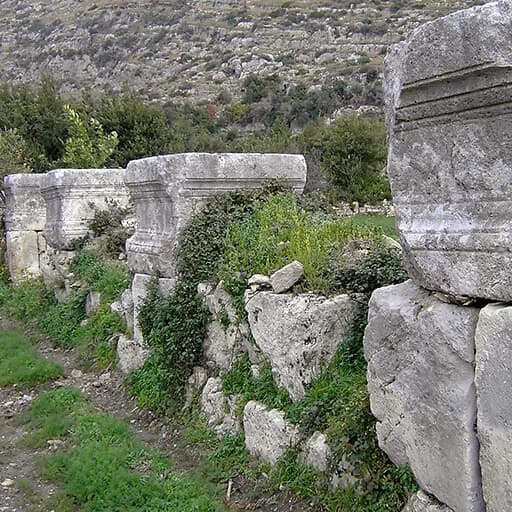
- Image: Htkava.