Biblical Settlement
Laodicea in the Bible
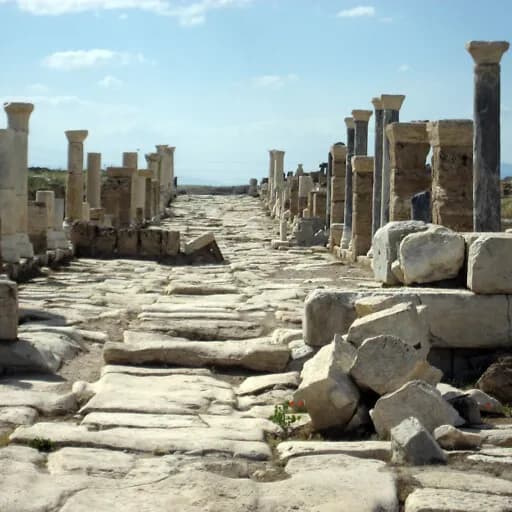
Laodicea is a settlement mentioned in 6 verses across 2 books of the Bible. Known today as Laodicea on the Lycus.
Verses
6
Books
2
Confidence
Very High
Coordinates
37.8358, 29.1075
Map
Loading map...
Key Verses About Laodicea
“and for those at Laodicea”Colossians 2:1 (KJV)
“that he has great zeal for you”Colossians 4:13 (KJV)
“and Nymphas”Colossians 4:15 (KJV)
“cause it to be read also in the assembly of the Laodiceans; and that you also read the letter from Laodicea.”Colossians 4:16 (KJV)
“{TR adds I am the Alpha and the Omega”Revelation 1:11 (KJV)
What Does “Laodicea” Mean?
What the Commentators Say
“**Verses 9-11** It was the apostle's comfort that he did not suffer as an evil-doer, but for the testimony of Jesus, for bearing witness to Christ as the Immanuel, the Saviour; and the Spirit of glory and of God rested upon this persecuted apostle. The day and time when he had this vision was the Lord's day, the Christian sabbath, the first day of the week, observed in remembrance of the resurrection of Christ. Let us who call him "Our Lord," honour him on his own day. The name shows how this sacred day should be observed; the Lord's day should be wholly devoted to the Lord, and none of its hours employed in a sensual, worldly manner, or in amusements. He was in a serious, heavenly, spiritual frame, under the gracious influences of the Spirit of God. Those who would enjoy communion with God on the Lord's day, must seek to draw their thoughts and affections from earthly things. And if believers are kept on the Lord's holy day, from public ordinances and the communion of saints, by necessity and not by choice, they may look for comfort in meditation and secret duties, from the influences of the Spirit; and by hearing the voice and contemplating the glory of their beloved Saviour, from whose gracious words and power no confinement or outward circumstances can separate them. An alarm was given as with the sound of the trumpet, and then the apostle heard the voice of Christ.”
Matthew Henry's Concise Commentary on Revelation 1:11
“(1-7) In these verses St. Paul declares his deep anxiety for the Colossians and Laodiceans and others who had not seen his face, that they might seek, not the false, but the true knowledge, finding “the mystery of God” in Christ alone. The reason of that anxiety is found in the “beguiling and enticing words” of an incipient Gnosticism. But “though absent in the body” he rejoices in the steadfastness of their faith, and only exhorts them to continue in it, deepening and enlarging it, but never changing its essence. (1) **What great conflict.**—The word is here repeated from the “striving” of the previous verse, which is, in the original, the cognate verb. It is the same word which is used in Philippians 1:30 (“conflict”), in 1Thessalonians 2:2 (“contention”), in 1Timothy 6:12, 2Timothy 4:7 (“the good fight of faith”). Evidently it describes the intense earnestness of the whole struggle against evil which he was undergoing for them; but perhaps, looking at Colossians 4:12, we may refer it especially to “striving in prayer” for them. It is probably dwelt upon here to show why, although unknown to them personally, he yet writes so urgently to them. **And for them at Laodicea.**—Comp. Colossians 4:13, “For you, and for them that are in Laodicea, and for them in Hierapolis.” These three cities lay near together in the valley of Lycus, a tributary of the Mæander; probably they were converted at one time, and are evidently regarded as forming one Christian community, for which Epaphras, the evangelist of Colossæ, felt himself responsible. Colossæ and Laodicea are actually directed to exchange the apostolic Letters sent to them (see Colossians 4:16, and Note there), and to read both alike in the churches. (See Dr. Lightfoot’s admirable description of “The Churches of the Lycus,” prefixed to his commentary on this Epistle.) Of Laodicea, the greatest and richest of the three cities, we have no further notice in Scripture, except that stern apocalyptic letter (Revelation 3:14-22), which has made its name proverbial for spiritual luke-warmness and presumptuous self-reliance. It has been noticed that in this Letter our Lord is called “the beginning of the creation of God.” (See Colossians 1:15-18 of this Epistle.) Of Colossæ and Hierapolis we read only in this Epistle. It is notable (see Dr. Lightfoot’s Essay) that while Hierapolis and Laodicea play a prominent part in the subsequent history of Christianity in Asia Minor, Colossæ never attains importance, and has left but “few and meagre” remains, compared with the magnificent ruins of the other cities. **As many as have not seen my face.**—This description doubtless indicates Hierapolis; but the whole context shows that it also includes Colossæ. If the reading taken in Colossians 1:7 is correct, Epaphras had been commissioned by St. Paul, and thus, indirectly, the Apostle might be held to be the founder of Colossæ. Accordingly this Letter stands, so to speak, midway between the unreserved familiarity of the Epistles to Corinth or Philippi, and the more formal reserve of the Epistle to the Romans.”
Ellicott's Commentary for English Readers on Colossians 2:1
Bible Verses Mentioning Laodicea
Learn More
Nearby Biblical Places
Related Resources
Attribution
- Geographic data from OpenBible.info Bible Geocoding Data licensed under CC BY 4.0.
- Map tiles by OpenStreetMap contributors (ODbL 1.0).
- Image: Rjdeadly.