Biblical River
Jordan in the Bible
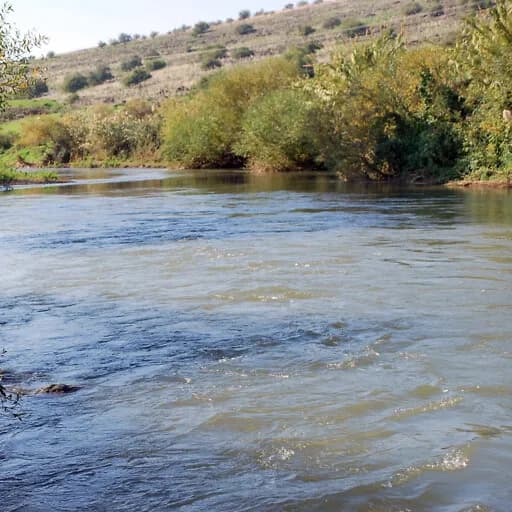
Jordan is a river mentioned in 202 verses across 21 books of the Bible. Known today as Jordan River.
Verses
202
Books
21
Confidence
Very High
Coordinates
31.7614, 35.5583
Map
Loading map...
Key Verses About Jordan
“and of all the truth”Genesis 32:10 (KJV)
“which is beyond the Jordan”Genesis 50:10 (KJV)
“the Canaanites”Genesis 50:11 (KJV)
“and the Jebusite”Numbers 13:29 (KJV)
“and encamped in the plains of Moab beyond the Jordan at Jericho.”Numbers 22:1 (KJV)
What Does “Jordan” Mean?
Ἰορδάνης (Iordánēs, Greek)
the Jordanes (i.e. Jarden), a river of Palestine
G2446 in Strong's Concordance →יַרְדֵּן (Yardên, Hebrew) — “descender”
Jarden, the principal river of Palestine
H3383 in Strong's Concordance →What the Commentators Say
“**Verses 9-23** Times of fear should be times of prayer: whatever causes fear, should drive us to our knees, to our God. Jacob had lately seen his guards of angels, but in this distress he applied to God, not to them; he knew they were his fellow-servants, Re 22:9. There cannot be a better pattern for true prayer than this. Here is a thankful acknowledgement of former undeserved favours; a humble confession of unworthiness; a plain statement of his fears and distress; a full reference of the whole affair to the Lord, and resting all his hopes on him. The best we can say to God in prayer, is what he has said to us. Thus he made the name of the Lord his strong tower, and could not but be safe. Jacob's fear did not make him sink into despair, nor did his prayer make him presume upon God's mercy, without the use of means. God answers prayers by teaching us to order our affairs aright. To pacify Esau, Jacob sent him a present. We must not despair of reconciling ourselves to those most angry against us.”
Matthew Henry's Concise Commentary on Genesis 32:10
“(10) **Threshingfloor of Atad.**—Atad means “a thorn-bush,” the *rhamnus paliurus *of Linnaeus, translated “bramble” in Judges 9:14. As agriculture was only beginning to be practised in Canaan, this threshing. floor would be common property, situated in some place easy of access, and probably a village would grow up near it. **Beyond Jordan.**—It is disputed whether this means on the east or on the west of the Jordan. It is certain that the route taken by Joseph lay to the east of the Dead Sea; for Goren-Atad is placed by Jerome at Beth-Hoglah, which lay between the Jordan and Jericho, and Joseph could have gone thither only by travelling through the territories of Moab and Amnion. This may seem a long detour, but, as may be seen in the Excursus on the Expedition of Chedorlaomer, the route through the wilderness of Judah was very difficult; and though the western shore of *the *Dead Sea was practicable as far as Engedi, it was necessary there to ascend a mountain-path so steep that a few Amorites might have guarded it against any number of invaders; and probably it was absolutely impracticable for chariots. It would have been easy, however, to reach Hebron through the Philistine country; but it is remarkable that we find hostilities going on between the descendants of Joseph and the Philistines (1Chronicles 7:21); and if raids were of common occurrence between the Semitic clans in Goshen and the Philistines, Joseph would not expose his father’s remains to the danger of an attack. Possibly they may even have refused their consent, and hence the attack upon them by Ephraim’s sons. On the other hand, the sons of Esau would show great respect to the body of their uncle—(Jewish tradition makes even the sons of Ishmael and of Keturah take part in the mourning)—and moreover they had not yet attained to any great power; and we gather from Esau’s march through the lands on the west of the Dead Sea (Genesis 32:6) that the natives there were too few and feeble to resist the chariots and horsemen which formed the escort. While therefore “beyond Jordan” would naturally mean “on the east of Jordan,” it may here express the fact that Joseph had just crossed the Jordan when the lamentation was made. The only other tenable explanation is that Goren-Atad was really on the eastern bank of the Jordan, and that though Beth-Hoglah was the nearest village, the two were not identical. It would be natural to make the solemn seven days’ mourning, either when just about to enter the Canaanite territory or at the tomb.”
Ellicott's Commentary for English Readers on Genesis 50:10
Bible Verses Mentioning Jordan
Numbers(21)
Deuteronomy(33)
Deuteronomy 1:1Deuteronomy 1:5Deuteronomy 2:29Deuteronomy 3:8Deuteronomy 3:17Deuteronomy 3:18Deuteronomy 3:20Deuteronomy 3:21Deuteronomy 3:25Deuteronomy 3:27Deuteronomy 3:28Deuteronomy 4:14Deuteronomy 4:21Deuteronomy 4:22Deuteronomy 4:26Deuteronomy 4:41Deuteronomy 4:46Deuteronomy 4:47Deuteronomy 4:49Deuteronomy 6:1Deuteronomy 9:1Deuteronomy 11:8Deuteronomy 11:11Deuteronomy 11:30Deuteronomy 11:31Deuteronomy 12:10Deuteronomy 27:2Deuteronomy 27:4Deuteronomy 27:12Deuteronomy 30:18Deuteronomy 31:2Deuteronomy 31:13Deuteronomy 32:47
Joshua(63)
Joshua 1:2Joshua 1:11Joshua 1:14Joshua 1:15Joshua 2:1Joshua 2:7Joshua 2:10Joshua 2:23Joshua 3:1Joshua 3:8Joshua 3:11Joshua 3:13Joshua 3:14Joshua 3:15Joshua 3:17Joshua 4:1Joshua 4:3Joshua 4:5Joshua 4:7Joshua 4:8Joshua 4:9Joshua 4:10Joshua 4:12Joshua 4:16Joshua 4:17Joshua 4:18Joshua 4:19Joshua 4:20Joshua 4:22Joshua 4:23Joshua 5:1Joshua 7:7Joshua 9:1Joshua 9:10Joshua 12:1Joshua 12:7Joshua 13:8Joshua 13:23Joshua 13:27Joshua 13:32Joshua 14:3Joshua 15:5Joshua 16:1Joshua 16:7Joshua 17:1Joshua 17:2Joshua 17:5Joshua 18:7Joshua 18:12Joshua 18:19Joshua 18:20Joshua 19:22Joshua 19:33Joshua 19:34Joshua 20:8Joshua 22:4Joshua 22:7Joshua 22:10Joshua 22:11Joshua 22:25Joshua 23:4Joshua 24:8Joshua 24:11
Judges(15)
2 Samuel(17)
2 Kings(9)
1 Chronicles(8)
Learn More
Nearby Biblical Places
Related Resources
Attribution
- Geographic data from OpenBible.info Bible Geocoding Data licensed under CC BY 4.0.
- Map tiles by OpenStreetMap contributors (ODbL 1.0).
- Image: Bill Rice.