Biblical Settlement
Calah in the Bible
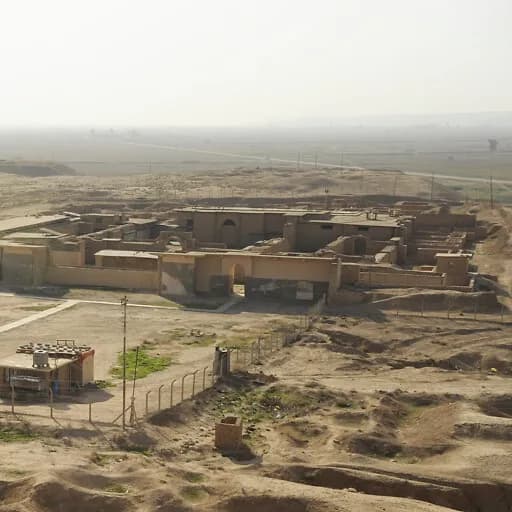
Calah is a settlement mentioned in 2 verses across 1 book of the Bible. Known today as Nimrud.
Verses
2
Books
1
Confidence
Very High
Coordinates
36.0981, 43.3289
Map
Loading map...
Key Verses About Calah
“and built Nineveh”Genesis 10:11 (KJV)
“And Resen between Nineveh and Calah: the same is a great city.”Genesis 10:12 (KJV)
What Does “Calah” Mean?
What the Commentators Say
“**Verses 8-14** Nimrod was a great man in his day; he began to be mighty in the earth, Those before him were content to be upon the same level with their neighbours, and though every man bare rule in his own house, yet no man pretended any further. Nimrod was resolved to lord it over his neighbours. The spirit of the giants before the flood, who became mighty men, and men of renown, Ge 6:4, revived in him. Nimrod was a great hunter. Hunting then was the method of preventing the hurtful increase of wild beasts. This required great courage and address, and thus gave an opportunity for Nimrod to command others, and gradually attached a number of men to one leader. From such a beginning, it is likely, that Nimrod began to rule, and to force others to submit. He invaded his neighbours' rights and properties, and persecuted innocent men; endeavouring to make all his own by force and violence. He carried on his oppressions and violence in defiance of God himself. Nimrod was a great ruler. Some way or other, by arts or arms, he got into power, and so founded a monarchy, which was the terror of the mighty, and bid fair to rule all the world. Nimrod was a great builder. Observe in Nimrod the nature of ambition. It is boundless; much would have more, and still cries, Give, give. It is restless; Nimrod, when he had four cities under his command, could not be content till he had four more. It is expensive; Nimrod will rather be at the charge of rearing cities, than not have the honour of ruling them. It is daring, and will stick at nothing. Nimrod's name signifies rebellion; tyrants to men are rebels to God. The days are coming, when conquerors will no longer be spoken of with praise, as in man's partial histories, but be branded with infamy, as in the impartial records of the Bible.”
Matthew Henry's Concise Commentary on Genesis 10:11
“(11, 12) **Out of that land went forth Asshur.**—So the LXX., Syriac, and Vulg.; but the Targum and most modern authorities rightly translate, “Out of that land he went forth into Assyria.” We have here nothing to do with Asshur the son of Shem (see Genesis 10:22), but are occupied with Nimrod and the Hamites, who, after firmly establishing themselves in Babylonia, subsequently extended their influence northward. This is confirmed by the cuneiform inscriptions, which prove that the southern portion of Mesopotamia was the chief seat of the Accadians, while in Assyria they came at an early date into collision with the Shemites, who drove them back, and ultimately subjugated them everywhere. It is not necessary to suppose that this spread of Hamite civilisation northward was the work of Nimrod personally; if done by his successors, it would, in Biblical language, be ascribed to its prime mover. The Assyrian cities were:— **1. Nineveh.**—So happily situated on the Tigris that it outstripped the more ancient Babylon, and for centuries even held it in subjection.** 2. The City Rehoboth.**—Translated by some *Rehoboth-Ir, *but with more probability by others, “the suburbs of the city:” that is, of Nineveh, thus denoting already the greatness of that town. **3. Calah.**—A city rebuilt by Assur-natzir-pal, the father of Shalmaneser, and interesting as one of the places where the Assyrian kings established libraries (*Chald. Gen., *p. 26). The ruins are still called Nimroud. **4. Resen.**—The “spring-head.” Of this town nothing certain is known. Canon Rawlinson places it at Selamiyah (*Anc. Mon., *1:204), a large village half-way between Nineveh and Calah. As the vast ruins scattered throughout Mesopotamia are those of Assyrian buildings, Resen, though “a great city” in Hamite times, might easily pass into oblivion, if never rebuilt by the conquerors.”
Ellicott's Commentary for English Readers on Genesis 10:11
People Connected to Calah
Bible Verses Mentioning Calah
Learn More
Nearby Biblical Places
Related Resources
Attribution
- Geographic data from OpenBible.info Bible Geocoding Data licensed under CC BY 4.0.
- Map tiles by OpenStreetMap contributors (ODbL 1.0).
- Image: Staff Sgt. JoAnn Makinano.