Biblical Settlement
Bethphage in the Bible
Bethphage is a settlement mentioned in 3 verses across 3 books of the Bible. Known today as Et Tur.
Verses
3
Books
3
Confidence
High
Coordinates
31.7776, 35.2508
Map
Loading map...
Key Verses About Bethphage
“and came to Bethsphage”Matthew 21:1 (KJV)
“to Bethsphage{TR & NU read Bethphage instead of Bethsphage} and Bethany”Mark 11:1 (KJV)
“when he drew near to Bethsphage{TR”Luke 19:29 (KJV)
What Does “Bethphage” Mean?
What the Commentators Say
“Chapter 21 Chapter Outline Christ enters Jerusalem.(1-11) He drives out those who profaned the temple.(12-17) The barren fig-tree cursed. (18-22) Jesus' discourse in the temple.(23-27) The parable of the two sons.(28-32) The parable of the wicked husbandmen.(33-46) **Verses 1-11** This coming of Christ was described by the prophet Zechariah, Zec 9:9. When Christ would appear in his glory, it is in his meekness, not in his majesty, in mercy to work salvation. As meekness and outward poverty were fully seen in Zion's King, and marked his triumphal entrance to Jerusalem, how wrong covetousness, ambition, and the pride of life must be in Zion's citizens! They brought the ass, but Jesus did not use it without the owner's consent. The trappings were such as came to hand. We must not think the clothes on our backs too dear to part with for the service of Christ. The chief priests and the elders afterwards joined with the multitude that abused him upon the cross; but none of them joined the multitude that did him honour. Those that take Christ for their King, must lay their all under his feet. Hosanna signifies, Save now, we beseech thee! Blessed is he that cometh in the name of the Lord! But of how little value is the applause of the people! The changing multitude join the cry of the day, whether it be Hosanna, or Crucify him. Multitudes often seem to approve the gospel, but few become consistent disciples. When Jesus was come into Jerusalem all the city was moved; some perhaps were moved with joy, who waited for the Consolation of Israel; others, of the Pharisees, were moved with envy. So various are the motions in the minds of men upon the approach of Christ's kingdom.”
Matthew Henry's Concise Commentary on Matthew 21:1
“XXI. (1) **And when they drew nigh unto Jerusalem.**—Here again we have, as far as we can, to fill up a gap in St. Matthew’s Gospel. We have to think of the journey up the narrow valley that leads from Jericho to Jerusalem. Our Lord, as before, was followed by the disciples, and they in their turn were followed by the crowds of pilgrims who were drawn to the Holy City either by the coming Passover or by wonder and curiosity to see what part the Prophet of Nazareth would take. Throughout the multitude, including the disciples, there was a feverish expectation that He would at last announce Himself as the Christ, and claim His kingdom (Luke 19:11). They reach Bethany “six days before the Passover,” probably, *i.e.,* on the Friday afternoon (John 12:1). They remain there for the Sabbath, probably in the house of Lazarus or Simon the leper (Matthew 26:6; John 12:2; and in that of the latter we have the history of the anointing, which St. Matthew relates, out of its chronological order, in Matthew 26:6-13). The point of time with which the narrative, which now becomes more continuous, opens, may be fixed at the dawn of the first day of the week, the daybreak of Palm Sunday. **Bethphage.**—The village is named in Luke 19:29, and in many MSS. of Mark 11:1, in conjunction with Bethany, and before it, and from this it would seem probable that it lay on the road from Jericho, and was therefore to the east of Bethany. The traditional site, however, followed in most maps, makes it to the west of Bethany, and nearer the summit of the hill. The name signified “the house of unripe figs,” as Bethany did “the house of dates,” and Gethsemane “the oil-press,” the three obviously indicating local features giving distinctness to the three sites. All three were on the Mount of Olives. Bethany is identified with the modern *El-’Azariyeh,* or *Lazarieh* (the name attaching to its connection with the history of Lazarus), which lies about a mile below the summit on the eastern slope of the Mount of Olives, in a woody hollow planted with olives, almonds, pomegranates, and figs. The palms implied in the name of Bethany and in the history of the entry into Jerusalem (John 12:13) have disappeared. **Two disciples.**—The messengers are not named in any of the Gospels. The fact that Peter and John were sent on a like errand in Luke 22:8 makes it, perhaps, probable that they were employed in this instance.”
Ellicott's Commentary for English Readers on Matthew 21:1
Bible Verses Mentioning Bethphage
Learn More
Nearby Biblical Places
Related Resources
Attribution
- Geographic data from OpenBible.info Bible Geocoding Data licensed under CC BY 4.0.
- Map tiles by OpenStreetMap contributors (ODbL 1.0).
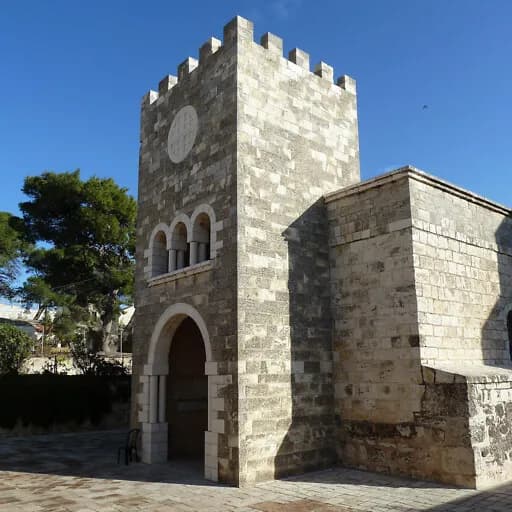
- Image: Djampa.