Biblical Settlement
Rabbah 1 in the Bible
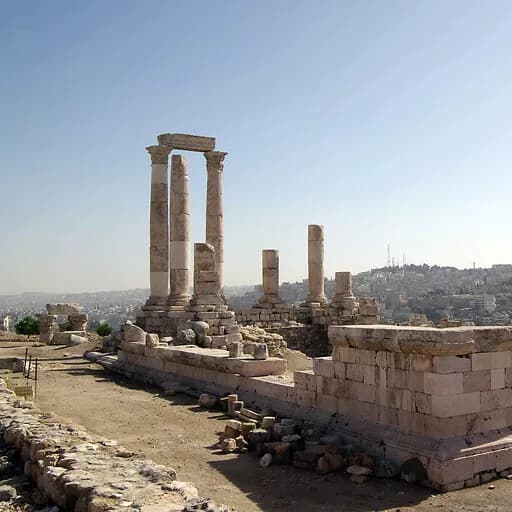
Rabbah 1 is a settlement mentioned in 17 verses across 7 books of the Bible. Known today as Amman.
Verses
17
Books
7
Confidence
Very High
Coordinates
31.9547, 35.9343
Map
Loading map...
Key Verses About Rabbah 1
“his bedstead was a bedstead of iron; isn't it in Rabbah of the children of Ammon? nine cubits was the length of it”Deuteronomy 3:11 (KJV)
“and all the cities of Gilead”Joshua 13:25 (KJV)
“at the return of the year”2 Samuel 11:1 (KJV)
“and took the royal city.”2 Samuel 12:26 (KJV)
“and said”2 Samuel 12:27 (KJV)
What the Commentators Say
“Chapter 3 Chapter Outline The conquest of Og king of Bashan.(1-11) The land of Gilead and Bashan.(12-20) Moses encourages Joshua.(21-29) **Verses 1-11** Og was very powerful, but he did not take warning by the ruin of Sihon, and desire conditions of peace. He trusted his own strength, and so was hardened to his destruction. Those not awakened by the judgments of God on others, ripen for the like judgments on themselves.”
Matthew Henry's Concise Commentary on Deuteronomy 3:11
“(11) **Of the remnant of giants**—i.e., of the nation of Rephaim in these parts. (See Note on Genesis 14:5.) **His bedstead.**—The word may mean either bedstead or coffin. Both the word for “bedstead” and the word for “iron” have given rise to some discussion and difficulty. An iron bedstead and an iron coffin are almost equally improbable. *Basalt *has been suggested as an alternative. But though there is basalt in Argob, there is none in Rabbath-Ammon. Conder, who has recently explored Rabbath, has discovered a remarkable throne of stone on the side of a hill there, and he suggests that the Hebrew word rendered “bedstead,” which properly signifies *a couch with a canopy, *may apply to this. The word for “iron” (b*arz*îl) in Talmudical language means also “*a prince,” *and this meaning has been suggested for the name *Barzillai, *which we find in the same district in later times. “His canopied throne was a princely one, and yet remains in Rabbath of the Ammonites,” would be the meaning of the passage, on this hypothesis. The dimensions of the throne recently discovered are said to be nearly those given in this verse. **After the cubit of a man**-*Ish *(not *adam*) the distinctive and emphatic word for a man. Some think that the cubit of *any man *is meant; others that the man himself for whom it was made, *viz., *Og, is intended. (Comp. Revelation 21:17, “according to the measure of a man—*i.e., *of an angel.”)”
Ellicott's Commentary for English Readers on Deuteronomy 3:11
Bible Verses Mentioning Rabbah 1
Learn More
Nearby Biblical Places
Related Resources
Attribution
- Geographic data from OpenBible.info Bible Geocoding Data licensed under CC BY 4.0.
- Map tiles by OpenStreetMap contributors (ODbL 1.0).
- Image: Berthold Werner.