Biblical Island
Caphtor in the Bible
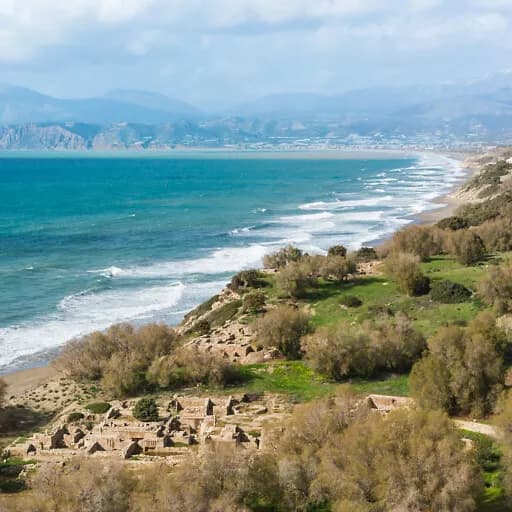
Caphtor is an island mentioned in 5 verses across 5 books of the Bible. Known today as Crete.
Verses
5
Books
5
Confidence
High
Coordinates
35.3097, 24.8933
Map
Loading map...
Key Verses About Caphtor
“Casluhim (which the Philistines descended from)”Genesis 10:14 (KJV)
“who lived in villages as far as Gaza”Deuteronomy 2:23 (KJV)
“and Casluhim (from whence came the Philistines)”1 Chronicles 1:12 (KJV)
“to cut off from Tyre and Sidon every helper who remains: for Yahweh will destroy the Philistines”Jeremiah 47:4 (KJV)
“children of Israel? says Yahweh. Haven't I brought up Israel out of the land of Egypt”Amos 9:7 (KJV)
What Does “Caphtor” Mean?
כַּפְתֹּר (Kaphtôr, Hebrew) — “a crown”
Caphtor (i.e. a wreath-shaped island), the original seat of the Philistines
H3731 in Strong's Concordance →What the Commentators Say
“**Verses 8-14** Nimrod was a great man in his day; he began to be mighty in the earth, Those before him were content to be upon the same level with their neighbours, and though every man bare rule in his own house, yet no man pretended any further. Nimrod was resolved to lord it over his neighbours. The spirit of the giants before the flood, who became mighty men, and men of renown, Ge 6:4, revived in him. Nimrod was a great hunter. Hunting then was the method of preventing the hurtful increase of wild beasts. This required great courage and address, and thus gave an opportunity for Nimrod to command others, and gradually attached a number of men to one leader. From such a beginning, it is likely, that Nimrod began to rule, and to force others to submit. He invaded his neighbours' rights and properties, and persecuted innocent men; endeavouring to make all his own by force and violence. He carried on his oppressions and violence in defiance of God himself. Nimrod was a great ruler. Some way or other, by arts or arms, he got into power, and so founded a monarchy, which was the terror of the mighty, and bid fair to rule all the world. Nimrod was a great builder. Observe in Nimrod the nature of ambition. It is boundless; much would have more, and still cries, Give, give. It is restless; Nimrod, when he had four cities under his command, could not be content till he had four more. It is expensive; Nimrod will rather be at the charge of rearing cities, than not have the honour of ruling them. It is daring, and will stick at nothing. Nimrod's name signifies rebellion; tyrants to men are rebels to God. The days are coming, when conquerors will no longer be spoken of with praise, as in man's partial histories, but be branded with infamy, as in the impartial records of the Bible.”
Matthew Henry's Concise Commentary on Genesis 10:14
“(23) **The Avims which dwelt in Hazerim, even unto Azzah, the Caphtorims . . . destroyed**.—“In Hazerim” should apparently be rendered “in villages.” It does not occur elsewhere as a proper name; it is plural in form, and is found in this sense in some other places. “Azzah,” *i.e., *Gaza. The Caphtorim: comp. Amos 9:7 : “The Philistines from Caphtor.” (See Genesis 10:14.) Some make the country of Caphtor to be Cyprus or Crete. But at least this statement makes Philistia the scene of a conquest, and the Philistines of the time of Joshua would thus appear to be a mixed race.”
Ellicott's Commentary for English Readers on Deuteronomy 2:23
People Connected to Caphtor
Bible Verses Mentioning Caphtor
Learn More
Nearby Biblical Places
Related Resources
Attribution
- Geographic data from OpenBible.info Bible Geocoding Data licensed under CC BY 4.0.
- Map tiles by OpenStreetMap contributors (ODbL 1.0).
- Image: Jebulon.