Biblical Settlement
Aiath in the Bible
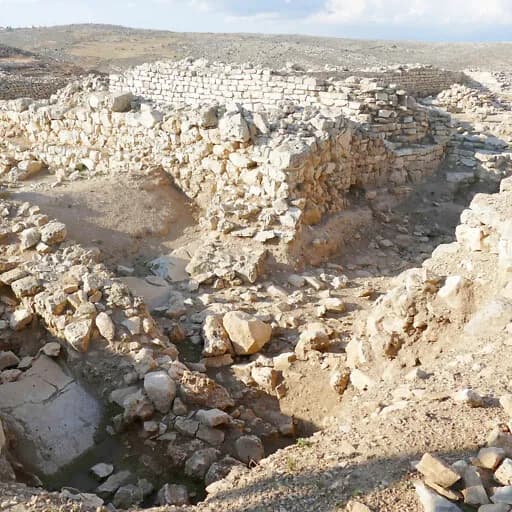
Aiath is a settlement mentioned in 1 verse across 1 book of the Bible. Known today as Et Tell.
Verses
1
Books
1
Confidence
High
Coordinates
31.9169, 35.2611
Map
Loading map...
Key Verses About Aiath
“He is come to Aiath”Isaiah 10:28 (KJV)
What the Commentators Say
“**Verses 20-34** By our afflictions we may learn not to make creatures our confidence. Those only can with comfort stay upon God, who return to him in truth, not in pretence and profession only. God will justly bring this wasting away on a provoking people, but will graciously set bounds to it. It is against the mind and will of God, that his people, whatever happens, should give way to fear. God's anger against his people is but for a moment; and when that is turned from us, we need not fear the fury of man. The rod with which he corrected his people, shall not only be laid aside, but thrown into the fire. To encourage God's people, the prophet puts them in mind of what God had formerly done against the enemies of his church. God's people shall be delivered from the Assyrians. Some think it looks to the deliverance of the Jews out of their captivity; and further yet, to the redemption of believers from the tyranny of sin and Satan. And this, "because of the anointing;" for his people Israel's sake, the believers among them that had received the unction of Divine grace. And for the sake of the Messiah, the Anointed of God. Here is, Is. 10:28-34, a prophetical description of Sennacherib's march towards Jerusalem, when he threatened to destroy that city. Then the Lord, in whom Hezekiah trusted, cut down his army like the hewing of a forest. Let us apply what is here written, to like matters in other ages of the church of Christ. Because of the anointing of our great Redeemer, the yoke of every antichrist must be broken from off his church: and if our souls partake of the unction of the Holy Spirit, complete and eternal deliverances will be secured to us.”
Matthew Henry's Concise Commentary on Isaiah 10:28
“(28) **He is come to Aiath . . .**—There is an obvious break between this and the preceding verse, and a new section begins, connected with the former by unity of subject, both referring to Sargon’s invasion of Judah. That such an invasion took place at or about the time of that king’s attack on Ashdod (Isaiah 20:1) the inscriptions leave no doubt. The Koujunyik cylinder names the king of Judah as having joined with the king of Ashdod; and in another, Sargon speaks of himself as “the subduer of the lands of Judah” (Layard, *Inscriptions, *xxxiii. 8). There is nothing in the passage itself to determine whether Isaiah 10:28-32 are predictive or historical, or when they were first uttered. Assuming that the Messianic prophecy of chap 11 is in close connection with them, it seems most probable that now, as in the earlier attack of Pekah and Rezin (Isaiah 7), as in the later invasion of Sennacherib (Isaiah 37), the bright vision of the future came to sustain the people when they were at their lowest point of depression. This would obviously be when Sargon’s armies were actually encamped round the city, when they had reached the last halting-place of the itinerary which Isaiah traces out. We may infer accordingly that the Assyrian armies were then at or near Nob, and that the prophet, supplied, either by human agency or supernaturally, with a knowledge of the movements of the Assyrian armies, describes their progress to a terrified and expectant people, and fixes the final goal. That progress we now have to trace. (1) Aiath is probably identical with the Ai of Joshua 7:2, the Aija of Nehemiah 11:31, in the tribe of Benjamin, not far from Bethel. (2) Migron. The route taken was not the usual one, but passed over three valleys, probably with a view to surprise Jerusalem by an unexpected attack. The modern name, *Bure Magrun, *survives, a short distance from Bethel. (3) Michmash. Now *Muchmas, *on the east side of the Migron valley. Here the carriages, *i.e., *the *baggage *(Acts 21:15; 1Samuel 17:22), the *impedimenta, *of the Assyrian army was left behind that the host might advance with greater rapidity to immediate action. (4) Geba, in the tribe of Benjamin (1Chronicles 6:60). Here, after defiling through the “passages,” probably the gorge of *Wady Suweinit *memorable for Jonathan s adventure (1Samuel 14:4-5), the army halted and encamped. (5) The panic spread rapidly to Ramah, memorable as the chief residence of Samuel (1Samuel 7:17). (6) The inhabitants of Gibeah, still retaining in its name its old association with the hero-king of Israel (1Samuel 11:4), left their town deserted and undefended. (7) Gallim, not now identifiable, but mentioned in 1Samuel 25:44. (8) Laieh, not the northern city of that name (Judges 18:29), but near Jerusalem. Read, *Listen, O Laish, *as if to the tramp of the armies as they passed. (9) Anathoth; about four miles north of Jerusalem, the birth-place of Jeremiah (Jeremiah 1:1). There is a special pathos in the prophet’s accents, a*nîyah Anathôth. *A various reading adopted by many critics gives, *Answer, O Anathoth. *(10) Madmenah, or Madmen, appears in Jeremiah 48:2, as a Moabite city. The name (“dung-hill”) was, however, not an uncommon one. It is named (Joshua 15:31) as one of the south-eastern cities of Judah. (11) The people of Gebim (“water-pits;” locality not identified) *gather their goods for flight. *(12) At last the army reaches Nob, memorable as having been one of the resting-places of the Tabernacle in the time of Saul (1Samuel 21:1). The site has not been identified with certainty, but it was obviously a position that commanded Jerusalem, between it and Anathoth, probably not far from the hill *Scopos *(“watch-tower”) where Titus and his troops encamped during the siege of Jerusalem. The prophet’s narrative leaves the invader there shaking his hand, as with defiant menace, against the holy city. For “that day,” read *this very day, *fixing, as it were, the very hour at which Isaiah spoke.”
Ellicott's Commentary for English Readers on Isaiah 10:28
Bible Verses Mentioning Aiath
Nearby Biblical Places
Related Resources
Attribution
- Geographic data from OpenBible.info Bible Geocoding Data licensed under CC BY 4.0.
- Map tiles by OpenStreetMap contributors (ODbL 1.0).
- Image: Bukvoed.